Sizing guide · Updated October 20, 2026
What size generator do you need to run a house?
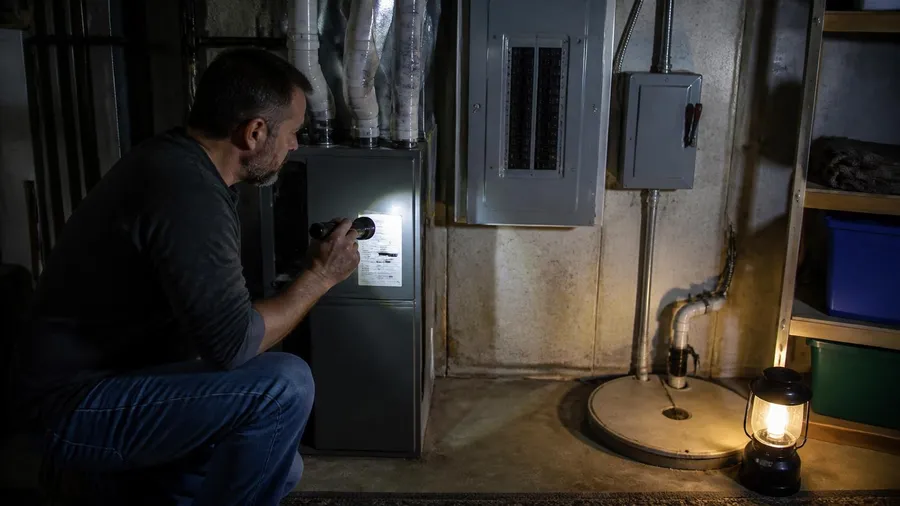
Add up the running watts of everything you need at once, then add the single biggest starting surge. On Honda and Champion chart figures, a gas-heat, city-water house (fridge, freezer, furnace blower, sump pump, lights, internet, microwave) runs at about 3,544 W and needs about 5,694 W at the worst start, so a 5,500–7,500 W generator covers it. A 240 V well pump pushes that to 6,694–9,544 W and needs a 120/240 V outlet and an inlet. Central air or an all-electric house is standby-generator territory: Generac puts most 2,000 sq ft homes at 18–22 kW.
Safety first: run a generator outdoors only, at least 20 feet from the house, exhaust pointed away from doors, windows and vents, and keep battery CO alarms working inside. Never backfeed through a wall or dryer outlet; hard-wired circuits need a transfer switch or a listed interlock with an inlet, installed by a licensed electrician (CDC). If anyone depends on powered medical equipment, plan that load first: see CPAP during a power outage.
The quick answer, by house
| What you want to run | Running watts | Worst start (Generac formula) | Worst start (one motor at a time) | Needs 240 V? | Generator class |
|---|---|---|---|---|---|
| Fridge, lights, internet and TV on extension cords | 602 W | 1,802 W | 1,610 W | No | 2,200 W inverter |
| Essentials, gas heat, city water; microwave only while the motors are idle | 2,544 W | 4,694 W | 3,644 W | No | 4,700 W+ starting (4,500 W if you stagger starts) |
| Essentials, gas heat, city water, all at once | 3,544 W | 5,694 W | 4,644 W | No | 5,500–7,500 W |
| Essentials + 1/2 hp well pump | 4,544 W | 6,694 W | 5,644 W | Yes | 5,500–7,500 W, 120/240 V |
| Essentials + 1 hp well pump | 5,544 W | 9,544 W | 7,544 W | Yes | 8,000–9,500 W, 120/240 V |
| Essentials + 1/2 hp well pump + 3-ton central AC | 8,044 W | 14,044 W | 10,544 W | Yes | 14–18 kW standby with AC soft start (Generac) |
| All-electric: add water heater, dryer and range | 20,044 W | 26,794 W | 22,544 W | Yes | 20–22 kW standby (Generac) |
Running watts and starting watts per load are in the next table. "Generac formula" is Generac's rule: the sum of all running watts plus the highest single starting wattage, which is conservative because it counts that motor's running watts twice. "One motor at a time" follows Honda's power-management advice: everything else running while one motor starts. Size to the Generac column if you can; the right-hand column is the floor if you stagger starts.
Running vs worst start, in watts
running extra needed for the worst start
Step 1: list the loads, with running and starting watts
Every motor has two numbers. Running watts are what it draws once it is turning. Starting watts are the one- or two-second burst to get the compressor or pump moving, often two to three times the running figure. Resistive loads like lights, a microwave or a water heater start at their running watts. Use the nameplate on your own appliances when you can; these are the manufacturer chart figures we used:
| Load | Running W | Starting W | Source |
|---|---|---|---|
| Refrigerator (ENERGY STAR) (132–192 W running; top of range used) | 192 | 1,200 | Honda |
| Freezer (ENERGY STAR) (same Honda row as the fridge) | 192 | 1,200 | Honda |
| Furnace blower, 1/3 hp (gas or oil heat) | 700 | 1,400 | Honda |
| Sump pump, 1/2 hp | 1,050 | 2,150 | Honda |
| LED lights, 10 bulbs × 10 W (8–15 W per bulb) | 100 | same | Champion |
| Internet router and modem (10–20 W) | 20 | same | Champion |
| Flat-screen TV, 46-inch | 190 | same | Honda |
| Phone and laptop charging (20–100 W) | 100 | same | Champion |
| Microwave, 650 W cooking power | 1,000 | same | Honda |
| Well pump, 1/2 hp (often 240 V) (750–1,000 / 1,500–2,000 W; top of range used) | 1,000 | 2,000 | Champion |
| Well pump, 1 hp (often 240 V) (1,000–2,000 / 2,000–4,000 W; top of range used) | 2,000 | 4,000 | Champion |
| Central AC, 3 ton (240 V) (3,000–3,500 / 5,000–6,000 W; Generac says starting can reach 15–18 kW without a soft start) | 3,500 | 6,000 | Champion |
| Electric water heater (240 V) | 4,500 | same | Honda |
| Electric clothes dryer (240 V) | 5,400 | 6,750 | Honda |
| Electric range, one 8-inch element (240 V) | 2,100 | same | Honda |
Charts disagree. Honda's current guide lists an ENERGY STAR fridge at 132–192 W running and 1,200 W starting; older charts, including the one behind our 30 amp inlet guide, use 700 W and 2,200 W as a worst case. Our fridge guide uses ENERGY STAR data for modern models: 41–82 W on average, with a 1,200 W start allowance.
Step 2: do the math (worked example)
Take the gas-heat, city-water essentials list: fridge, freezer, furnace blower, sump pump, ten LED bulbs, internet, a TV, chargers and a microwave. Running watts add up to 3,544 W. The biggest starting number is the 1/2 hp sump pump at 2,150 W. Generac's formula adds them: 3,544 + 2,150 = 5,694 W. If the pump kicks on while everything else is already running, the real surge is a bit lower, 3,544 − 1,050 + 2,150 = 4,644 W, but you don't control when a sump float or a fridge compressor starts.
So you want a generator with at least 3,544 running watts and about 5,694 starting watts. Leave the microwave for when the pumps and furnace are idle and you drop to 2,544 W running and 4,694 W at the worst start, which is how a mid-size inverter generator gets through a night. Remember that running a generator near its rated watts for hours cuts fuel runtime and raises noise; Honda's own runtime figures are quoted at rated load and at 1/4 load for that reason.
Step 3: check voltage and how it connects
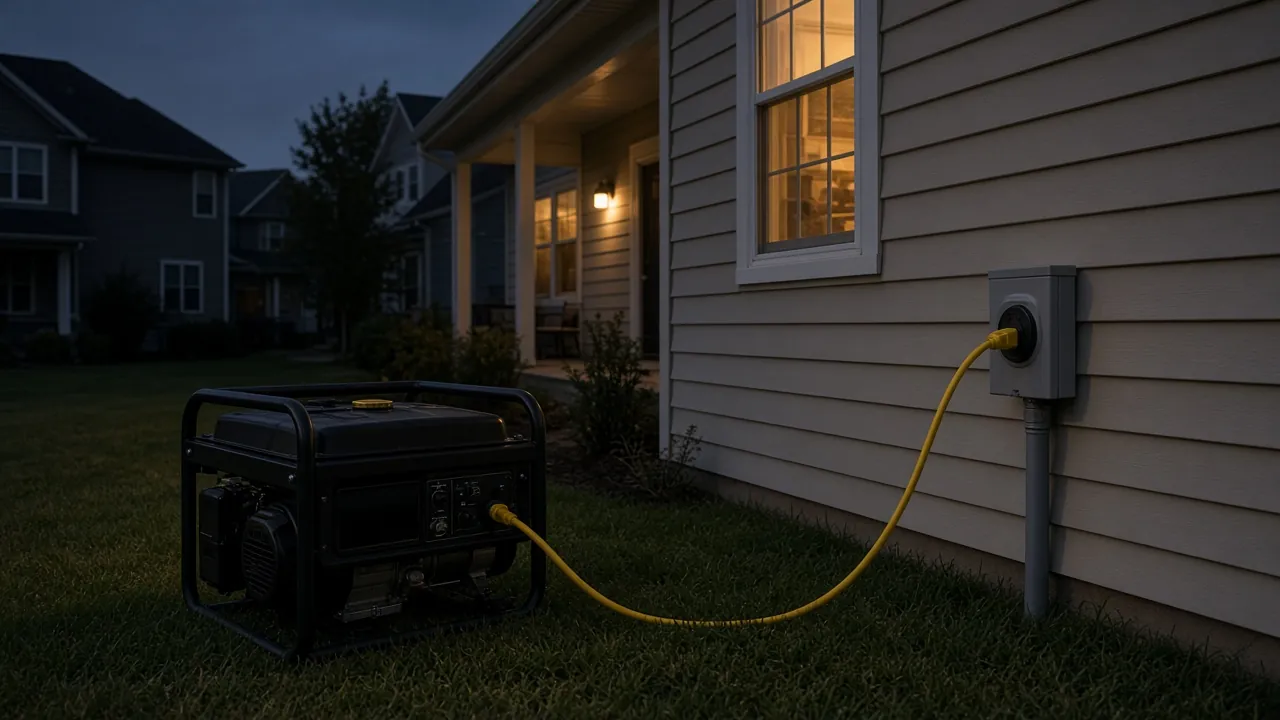
- Plug-in loads only. A fridge, lamps, router and TV can run on heavy extension cords from any generator. A furnace, sump pump on a dedicated circuit or a well pump is hard-wired, so it needs a transfer switch or an interlock and inlet.
- 240 V loads. Most deep-well pumps, central AC, electric water heaters, dryers and ranges are 240 V. They need a generator with a 120/240 V outlet (L14-30R or 14-50R) feeding an inlet. A 120 V L5-30R or the RV-style TT-30R can't run them.
- Inlet limits. A 30 A, 120/240 V inlet carries at most 30 × 240 = 7,200 W; a 50 A inlet, 50 × 240 = 12,000 W. A bigger generator behind a 30 A inlet only helps with starting surges. Details: whole house via a 30 amp inlet.
- Clean power. Inverter generators typically publish under 3% total harmonic distortion, which is what you want for electronics, furnace control boards and medical devices. Open-frame models are cheaper per watt but often don't publish THD.
Well pumps need more generator than their watts suggest
A submersible pump draws a hard surge, and an undersized generator lets the voltage sag until the motor stalls. Franklin Electric's AIM manual lists the smallest generator for the pump on its own (continuous-duty, externally regulated; internally regulated generators can be smaller):
| Pump motor | 3-wire motor | 2-wire motor (+50%) |
|---|---|---|
| 1/3 hp | 1.5 kW | 2.25 kW |
| 1/2 hp | 2 kW | 3 kW |
| 3/4 hp | 3 kW | 4.5 kW |
| 1 hp | 4 kW | 6 kW |
| 1.5 hp | 5 kW | 7.5 kW |
Source: Franklin Electric AIM manual, engine-driven generator tables (2026 60 Hz edition PDF). Franklin also says to start the generator before the pump and shut the pump off before the generator, because a coasting generator can damage the motor's thrust bearing. That is the pump alone; add the running watts of everything else that is on when it starts.
Central air is what turns a portable job into a standby job
Champion's chart puts a 3-ton central AC at 3,000–3,500 W running and 5,000–6,000 W starting. Generac is blunter: 3.5–5 kW running, and up to 15–18 kW to start the compressor without help. That gap is why the compressor nameplate matters: look for LRA (locked-rotor amps). LRA × 240 V is roughly the worst-case starting load. A soft-start kit cuts that surge, and Generac's answer for a 3-ton unit is a 14–18 kW standby generator with a load manager or soft start rather than a bigger generator. Add the AC to the essentials and you are at 8,044 W running before any start, already more than a 30 A inlet can carry.
Go all-electric (water heater, dryer, range) and the chart total reaches 20,044 W running, which lines up with Generac's 20–22 kW recommendation for whole-home coverage of a 2,000 sq ft house. Generac also stresses that square footage is only a starting point; two identical floor plans can differ by 8 kW depending on heat source, well and AC.
Generators that clear each tier
From the 20 generators in our data, using the gasoline running and starting watts on each maker's spec page. "Clears" means running watts ≥ the running total and starting watts ≥ the Generac-formula worst start.
Fridge, lights, internet on cords
1,800 W running · 2,200 W starting · inverter · no 30 A outlet
Covers the 602 W cord list with a 1,802 W worst start. Quiet inverter with a CO-MINDER shutoff; 3.2 hr at rated load, 8.1 hr at 1/4 load.
Essentials, managed starts
3,700 W running · 4,500 W starting · inverter · TT-30R
Clears the managed essentials list one motor at a time (3,644 W) but not by the Generac formula (4,694 W), so stagger starts. Dual fuel, CO shutoff, TT-30R (120 V only).
Essentials, all at once, inverter
5,500 W running · 7,000 W starting · inverter · L14-30R
5,500 W running and an L14-30R for an inlet. Covers the full 3,544 W / 5,694 W essentials list with clean inverter power.
Essentials + 1/2 hp well pump
Champion 7500W Dual Fuel (100891)
7,500 W running · 9,375 W starting · open-frame · L14-30R
7,500 W running fills a 30 A inlet; 9,375 W starting covers the 6,694 W worst start. Dual fuel (6,750 W on propane).
Essentials + 1 hp well pump
8,000 W running · 10,000 W starting · open-frame · L14-30R
10,000 W starting clears the 9,544 W worst start; COsense shutdown; L14-30R. Through a 30 A inlet, running is still capped at 7,200 W.
Bigger margin, 50 A inlet
9,500 W running · 12,500 W starting · open-frame · L14-30R
9,500 W running and 12,500 W starting, with both L14-30R and 14-50R outlets, so it can use a 50 A inlet (12,000 W). Dual fuel.
Generator specs are from the maker pages linked on each generator page. For standby sizing with central air, get a dealer load calculation; Generac's air-cooled standby range is 10–28 kW. As an Amazon Associate we earn from qualifying purchases.
Battery CO alarms on AmazonKill A Watt meter on Amazon
Every generator in our data against each tier
| Generator | Running / starting W | Cords | Essentials | + 1/2 hp well | + 1 hp well |
|---|---|---|---|---|---|
| Honda EU2200i | 1,800 / 2,200 | Clears | Too small | No 240 V | No 240 V |
| Westinghouse iGen2200 | 1,800 / 2,200 | Clears | Too small | No 240 V | No 240 V |
| Champion 2500W Ultralight Inverter (200951) | 1,850 / 2,500 | Clears | Too small | No 240 V | No 240 V |
| Honda EU3000iS | 2,800 / 3,000 | Clears | Too small | No 240 V | No 240 V |
| Generac iQ3500 COsense | 3,000 / 3,500 | Clears | Too small | No 240 V | No 240 V |
| Generac GP3500iO | 3,000 / 3,500 | Clears | Too small | No 240 V | No 240 V |
| Predator 3500 Super Quiet Inverter | 3,000 / 3,500 | Clears | Too small | No 240 V | No 240 V |
| WEN 56380i | 3,400 / 3,800 | Clears | Too small | No 240 V | No 240 V |
| Champion 4500W Dual Fuel Inverter (200988) | 3,500 / 4,500 | Clears | Too small | No 240 V | No 240 V |
| Westinghouse iGen4500DFc | 3,700 / 4,500 | Clears | Too small | No 240 V | No 240 V |
| Honda EU7000iS | 5,500 / 7,000 | Clears | Clears | Clears | Too small |
| Champion 7500W Dual Fuel (100891) | 7,500 / 9,375 | Clears | Clears | Clears | Stagger starts |
| FIRMAN T07571 Tri Fuel | 7,500 / 9,400 | Clears | Clears | Clears | Stagger starts |
| Predator 9500 Super Quiet Inverter | 7,600 / 9,500 | Clears | Clears | Clears | Stagger starts |
| Generac GP8000E COsense | 8,000 / 10,000 | Clears | Clears | Clears | Clears |
| WEN DF1100T | 8,300 / 11,000 | Clears | Clears | Clears | Clears |
| DuroMax XP12000EH | 9,500 / 12,000 | Clears | Clears | Clears | Clears |
| Pulsar G12KBN | 9,500 / 12,000 | Clears | Clears | Clears | Clears |
| Westinghouse WGen9500DF | 9,500 / 12,500 | Clears | Clears | Clears | Clears |
| DuroMax XP13000EH | 10,500 / 13,000 | Clears | Clears | Clears | Clears |
"Stagger starts" means the generator clears the one-motor-at-a-time figure but not the Generac formula. "No 240 V" means no L14-30R, 120/240 V 30 A twist-lock or 14-50R outlet in the maker's spec. None of these portable units clears the central-AC or all-electric tiers.
Generator or batteries?
For a fridge, CPAP, router and lights through an overnight outage, a portable power station is quieter and needs no fuel or extension-cord run outside. For multi-day outages, a well pump, or anything 240 V, a generator wins. Many households pair them: run the generator in the day, the battery at night. See generator vs power station, the fridge outage guide and best power station for a sump pump.
Sources
- Honda Power Equipment: What wattage generator do I need? (home wattage chart)
- Honda Power Equipment: What size generator do I need? (power management)
- Champion Power Equipment: Generator wattage chart
- Generac: What size generator do I need? (August 9, 2026)
- Franklin Electric: AIM manual resources
- Franklin Electric AIM manual, 2026 60 Hz edition (engine-driven generator tables)
- CDC: What to do to protect yourself during a power outage
- Generator running and starting watts, outlets and runtimes: the maker source linked on each generator page.
Other guides
- What size generator for a 30 amp inlet
- Whole house on a generator via a 30 amp inlet
- Best generator for home backup
- Quietest inverter generators
- Generator vs power station
- Best power station for home backup
Questions
What size generator do I need to run a whole house?
For true whole-house coverage including central AC and electric appliances, a home standby generator in the 18–22 kW range is typical; Generac calls 22 kW the industry standard for whole-home protection on 2,500–3,000 sq ft houses. On chart figures, an all-electric house with a 3-ton AC, well pump, water heater, dryer and range adds up to about 20,044 W running. A portable generator through a 30 A inlet can deliver at most 7,200 W, so it covers essential circuits, not the whole house.
Can a 7,500 watt generator run a house?
It can run the essentials. Our gas-heat, city-water essentials list is about 3,544 W running and 5,694 W at the worst start, and with a 1/2 hp well pump it is 4,544 W running and 6,694 W at start, inside a 7,500 W generator with 9,000+ W starting. It will not run central air, an electric water heater and a dryer together.
Can a 3,500 watt generator run a house?
Only a slice of it. Fridge, freezer, furnace blower, lights, internet and TV come to about 1,494 W running, which fits, but the sump pump and microwave push the total past 3,500 W. Start one motor at a time and skip 240 V loads; a 3,500 W unit has no 240 V outlet.
What size generator do I need for a 2,000 square foot house?
Square footage is only a starting point. Generac says a 2,000 sq ft house typically needs 20–22 kW for whole-home coverage, but the same house with gas heat, city water and no central AC can get through an outage on essential circuits with a 5,500–7,500 W portable generator. List your loads instead of using floor area.
What size generator do I need for a well pump?
Franklin Electric's AIM manual lists the minimum generator for the pump alone: 2 kW for a 1/2 hp 3-wire motor and 4 kW for 1 hp (externally regulated generators), and 50% more for 2-wire motors (3 kW and 6 kW). Add everything else that runs while the pump starts. Most deep-well pumps are 240 V, so the generator needs a 120/240 V outlet.
Do I need a transfer switch?
To power anything hard-wired (a furnace, well pump, sump pump on a circuit, central AC), yes: a transfer switch or a listed interlock with a power inlet box, installed by a licensed electrician. Never backfeed through a dryer or wall outlet. Extension cords are fine only for plug-in appliances.