Generator guide · Maker specs checked November 2, 2026
What can a 2,000-watt generator run? Fridge, furnace, sump, AC and more
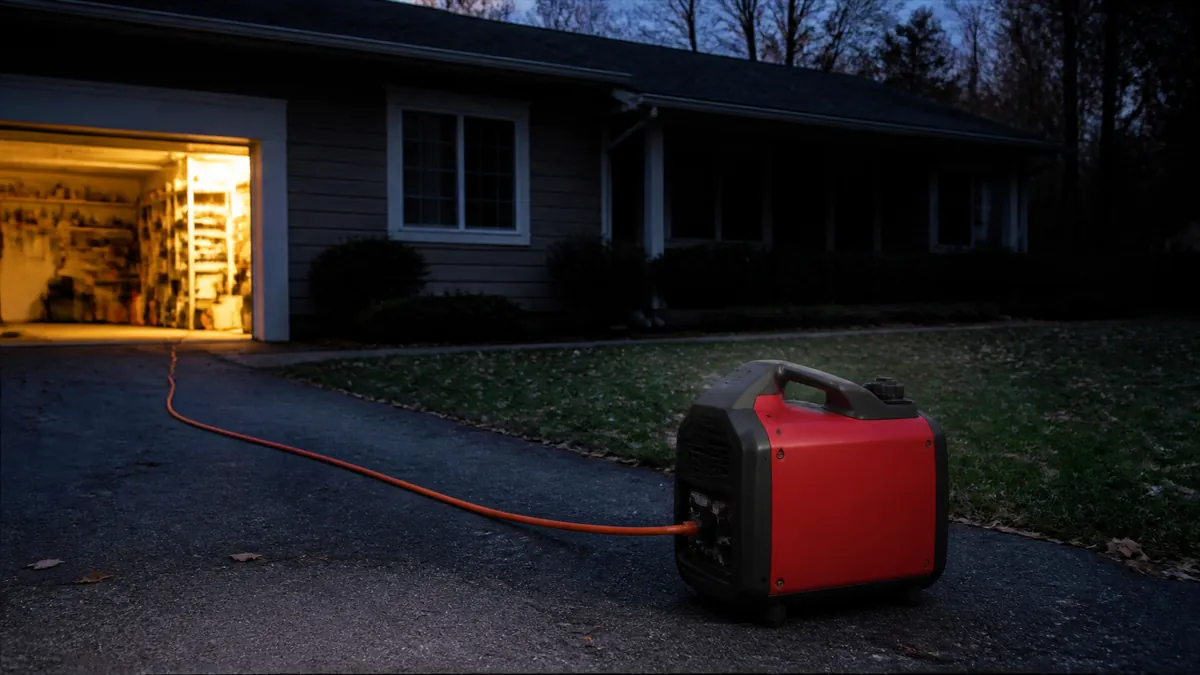
A 2,000-watt-class inverter generator really gives you about 1,800 running watts, so it can carry the outage basics: a fridge, a freezer, LED lights, the router, a TV and phone chargers add up to about 794 W running, and about 1,802 W at the moment the fridge compressor kicks on. It can also run a gas furnace blower, a 1/3 hp sump pump or a coffee maker alongside the fridge, one big load at a time. It cannot run anything on 240 V (well pumps, electric water heaters, dryers, ranges, central AC), and a 10,000 BTU window AC or a 13,500 BTU RV roof unit uses almost the whole thing. If you need two motors starting together, look at a 2,500 W unit or a parallel pair.
What "2,000 watts" really means
Almost every generator sold as a "2,000-watt" or "2,200-watt" model has two numbers. The big one on the box is the maximum (also called peak or starting) watts, which the generator can deliver for a short time while a motor starts. The number that matters for planning is the rated (running) watts it can hold continuously. For the three most popular models in this class:
| Generator | Rated (running) W | Maximum (starting) W | Outlets | Tank | Runtime (maker) | Weight | Noise (maker) | CO shutoff |
|---|---|---|---|---|---|---|---|---|
| Honda EU2200i | 1,800 (15 A) | 2,200 (18.3 A) | 20 A 125 V duplex | 0.95 gal | 3.2 h at rated, 8.1 h at 1/4 load | 47.4 lb | 57 dB(A) rated, 48 at 1/4 | Yes, CO-MINDER |
| Westinghouse iGen2200 | 1,800 (15 A) | 2,200 (18.3 A) | Duplex 5-20R, 2 USB | 1.14 gal | Up to 12 h at 25% | 46.3 lb | As low as 52 dBA | No (per spec table) |
| Champion 200951 | 1,850 (15.4 A) | 2,500 | 20 A duplex 5-20R, 12 V DC | 1.1 gal | 11.5 h at 25% | 39 lb | 53 dBA at 23 ft | No; CO Shield version is model 201317 |
Sources: Honda EU2200i specifications, Westinghouse iGen2200 product page, Champion 200951 operator's manual and sell sheet. Noise figures are measured differently by each maker, so compare them loosely.
So treat a "2,000 W" generator as an 1,800 W generator with a short-term 2,200 W (or 2,500 W) allowance for motor starts. Two more rules of thumb help:
- Running watts add up. Everything that is on at the same time counts against the 1,800 W rating.
- Starting watts don't all add up. Honda recommends adding the running watts of everything, then the extra starting watts of the one motor that starts last. That is how we worked out every combination below: running total, plus the biggest single start-up jump. If two motors (say a fridge and a sump pump) happen to start at the same moment, the peak is higher.
- Altitude costs power. Micro-Air notes generators lose about 3.5% of their output per 1,000 feet of elevation. At 5,000 ft an 1,800 W generator is closer to 1,485 W.
What a 2,000 W generator can run, item by item
These are the published running and starting figures for common loads, mostly from Honda's wattage chart. The verdict compares each item on its own with an 1,800 W rated / 2,200 W maximum generator (EU2200i, iGen2200) and the 1,850 / 2,500 W Champion 200951. Your appliance's nameplate always wins over a generic chart.
| Load | Running W | Starting W | Source | On a 2,000 W-class generator |
|---|---|---|---|---|
| Refrigerator or freezer (ENERGY STAR) Honda lists 132–192 W running; we use 192 | 192 | 1,200 | Honda chart | Yes |
| LED lights, 10 bulbs × 10 W Champion: 8–15 W per bulb | 100 | 100 | Champion chart | Yes |
| Internet modem and router Champion: 10–20 W | 20 | 20 | Champion chart | Yes |
| Flat-screen TV, 46-inch | 190 | 190 | Honda chart | Yes |
| Phone and laptop charging Champion: 20–100 W | 100 | 100 | Champion chart | Yes |
| Laptop computer Honda: 200–250 W | 250 | 250 | Honda chart | Yes |
| Desktop computer Honda: 600–800 W | 800 | 800 | Honda chart | Yes |
| ResMed AirSense 11 CPAP typical system figure from the user guide (peak 73.2 W) | 56 | 56 | ResMed user guide | Yes |
| Portable fan | 40 | 120 | Honda chart | Yes |
| Coffee maker, 4-cup | 600 | 600 | Honda chart | Yes |
| Microwave, 650 W cooking power | 1,000 | 1,000 | Honda chart | Yes |
| Microwave, 1,000 W cooking power | 1,500 | 1,500 | Honda chart | Yes |
| Electric fry pan | 1,500 | 1,500 | Honda chart | Yes |
| Slow cooker Honda: 170–270 W | 270 | 270 | Honda chart | Yes |
| Lasko 755320 ceramic space heater, high 12.5 A; low is 900 W | 1,500 | 1,500 | Lasko listing | Yes |
| Hair dryer, 1,600 W | 1,800 | 1,900 | Honda chart | At the limit (100% of rated) |
| Furnace blower, 1/3 hp (gas or oil heat) | 700 | 1,400 | Honda chart | Yes |
| Furnace blower, 1/2 hp | 875 | 2,350 | Honda chart | Champion 2,500 W only |
| Sump pump, 1/3 hp | 800 | 1,300 | Honda chart | Yes |
| Sump pump, 1/2 hp | 1,050 | 2,150 | Honda chart | Yes |
| Window air conditioner, 10,000 BTU check your nameplate amps; many newer units draw less | 1,500 | 2,200 | Honda chart | At the 2,200 W maximum; fits the 2,500 W Champion |
| Washing machine | 1,200 | 1,200 | Honda chart | Yes |
| Dishwasher (cool dry) | 216 | 540 | Honda chart | Yes |
| Garage door opener | 720 | 1,420 | Honda chart | Yes |
| RV refrigerator on AC | 180 | 600 | Honda chart | Yes |
| RV roof AC, 11,000 BTU | 1,010 | 1,600 | Honda chart | Yes |
| RV roof AC, 13,500 BTU | 1,800 | 2,800 | Honda chart | Only with a soft starter |
| RV roof AC, 15,000 BTU | 2,000 | 3,300 | Honda chart | No: running watts too high |
| Circular saw, 7-1/4 in. heavy duty | 1,400 | 2,300 | Honda chart | Champion 2,500 W only |
| Drill, 1/2 in., 5.4 A | 600 | 900 | Honda chart | Yes |
| Air compressor, 1/2 hp | 975 | 1,600 | Honda chart | Yes |
| Electric water heater (240 V) 240 V | 4,500 | 4,500 | Honda chart | No: needs 240 V |
| Electric clothes dryer (240 V) 240 V | 5,400 | 6,750 | Honda chart | No: needs 240 V |
Three patterns jump out. Kitchen heat (microwave, coffee maker, fry pan, space heater) is pure running watts with no start-up spike, so it fits as long as it is the only big thing on. Motors (fridge, furnace blower, sump pump, compressor) start at two to three times their running watts, so the maximum rating matters more than the rated one. And heavy 120 V loads such as a 1,600 W hair dryer or a 15,000 BTU RV air conditioner use the whole generator or more.
Real combinations, worked out
Nobody runs one thing during an outage. Here is what happens when you stack common loads, using Honda's method (all running watts, plus the biggest single start-up jump):
| Scenario | Running W | Peak W | % of 1,800 W | EU2200i / iGen2200 | Champion 200951 |
|---|---|---|---|---|---|
| Outage basics: fridge, freezer, LED lights, router, TV, chargers | 794 | 1,802 | 44% | ✅ Yes | ✅ Yes |
| Winter: fridge, 1/3 hp furnace blower, lights, router, chargers | 1,112 | 2,120 | 62% | ✅ Yes | ✅ Yes |
| Wet basement: fridge, 1/2 hp sump pump, lights, router | 1,362 | 2,462 | 76% | ❌ No | ✅ Yes |
| Breakfast: fridge, coffee maker, lights | 892 | 1,900 | 50% | ✅ Yes | ✅ Yes |
| Kitchen: fridge plus a 650 W microwave | 1,192 | 2,200 | 66% | ✅ Yes | ✅ Yes |
| Bedroom: CPAP, portable fan, phone charging, a few lights | 296 | 376 | 16% | ✅ Yes | ✅ Yes |
| Home office: desktop computer, laptop, router, lights | 1,170 | 1,170 | 65% | ✅ Yes | ✅ Yes |
| Summer: 10,000 BTU window AC, fridge, lights, router | 1,812 | 2,820 | 101% | ❌ No | ❌ No |
| Cold room: space heater on high plus the fridge | 1,692 | 2,700 | 94% | ❌ No | ❌ No |
| RV dry camping: RV fridge on AC, TV, laptop, fan | 660 | 1,080 | 37% | ✅ Yes | ✅ Yes |
| Jobsite: 7-1/4 in. circular saw and a work light | 1,500 | 2,400 | 83% | ❌ No | ✅ Yes |
What this tells you:
- The outage basics are easy. Fridge, freezer, lights, internet and TV are only about 794 W running, under half the rating. That leaves room to plug in a coffee maker or a 650 W microwave for a few minutes, as long as you do it while the fridge compressor is already running.
- Gas heat works. A 1/3 hp furnace blower plus the fridge peaks at about 2,120 W, inside the 2,200 W maximum. Hooking a furnace up correctly is the hard part, not the watts (see safety).
- A 1/2 hp sump pump is where 2,200 W runs out. With the fridge running, starting the pump peaks at about 2,462 W: over 2,200 W, just under the Champion's 2,500 W. If the fridge and pump start at the same moment, the peak is closer to 3,470 W, which none of these can do. Our sump pump guide covers battery and DC backup options.
- Heat and cooling eat everything. A space heater on high or a 10,000 BTU window AC leaves no room for a fridge start. Either run them alone, or step down (900 W heater setting, a smaller AC).
For a whole-house view with well pumps and central air, see what size generator do you need to run a house. Most homes that want more than the basics end up in the 3,500–7,500 W class.
What a 2,000 W generator can't run
- Anything on 240 V. These generators are 120 V only. Honda's chart flags the electric water heater (4,500 W), electric dryer (5,400 W running, 6,750 W starting) and electric range as 240 V loads, and most deep-well pumps and all central AC condensers are 240 V as well.
- A transfer switch that expects 30 A at 240 V. There is no L14-30 outlet. You can feed a 120 V circuit or two through a properly installed inlet and interlock, but not the whole panel. See generator size for a 30 amp inlet.
- Two big heat loads at once. A 1,500 W space heater plus a 1,000 W microwave is 2,500 W running.
- A 15,000 BTU RV air conditioner. Honda lists 2,000 W running, more than any of these can hold.
- Big shop tools. Honda lists a 10-inch table saw at 4,500 W starting and a 1 hp air compressor at 4,500 W starting.
Air conditioners: window units and RV roof units
Window units. Honda's generic 10,000 BTU window AC is 1,500 W running and 2,200 W starting. That is exactly the maximum of an EU2200i or iGen2200, so it may start on a fresh, warm generator and then leave you with only about 300 W for everything else. The real number for your unit is on its nameplate: amps × 120 V gives running watts. Smaller units are a far better match; our appliance pages list maker wattages for ENERGY STAR window units such as the BLACK+DECKER BDM05C (about 347 W), GE PWJV10 (625 W) and BLACK+DECKER BD12NWES (800 W).
RV roof units. Honda lists 11,000 BTU at 1,010 W running / 1,600 W starting (fits), 13,500 BTU at 1,800 / 2,800 W, and 15,000 BTU at 2,000 / 3,300 W. The 13.5K unit is the common case, and it is too hard a start for a stock 2,200 W generator. Micro-Air, which makes the EasyStart soft starter, says a 13.5K unit with an EasyStart can start on a 2,000 W inverter generator, and that the unit draws about 15 A on a hot day. At 120 V that is 1,800 W, the whole rating, so turn the converter charger, water heater and microwave off while the AC runs, and keep the RV fridge on propane. At altitude, or for a 15K unit, plan on two generators in parallel. Our RV guide has the full roof-AC math, including battery stations.
Fuel: how long a tank lasts
Small inverter generators throttle the engine down at light loads (Honda calls it Eco Throttle; Westinghouse and Champion call it Economy Mode), which is why the quarter-load runtimes are so much longer than the full-load ones. Using each maker's own runtime and tank size:
| Generator | Maker runtime | Fuel use | Delivered energy | 24 h at 1/4 load |
|---|---|---|---|---|
| Honda EU2200i, rated load (1,800 W) | 3.2 h on 0.95 gal | 0.30 gal/h | about 6,063 Wh per gallon | — |
| Honda EU2200i, 1/4 load (450 W) | 8.1 h on 0.95 gal | 0.12 gal/h | about 3,837 Wh per gallon | about 2.8 gal |
| Westinghouse iGen2200, 25% (450 W) | up to 12 h on 1.14 gal | 0.095 gal/h | about 4,737 Wh per gallon | about 2.3 gal |
| Champion 200951, 25% (about 463 W) | 11.5 h on 1.1 gal | 0.096 gal/h | about 4,835 Wh per gallon | about 2.3 gal |
Two practical takeaways. First, light loads burn less fuel per hour but deliver fewer watt-hours per gallon: by Honda's figures the EU2200i turns a gallon into about 6,063 Wh at full load but about 3,837 Wh at a quarter load. If you only need power for a fridge and lights, running the generator a few hours at a time to recharge a battery power station can stretch fuel further. Second, these tanks are small. Even at light load you are refilling every 8–12 hours, so a three-day outage needs roughly 8–7 gallons of stored fuel for nonstop running. Shut the engine off and let it cool before you refuel, as every owner's manual instructs. Our 3-day outage plan compares fuel, battery and solar.
Need more? Parallel kits
All three of these generators can be paired with a second identical unit for roughly double the power:
- Honda says two EU2200i units can be paralleled with an optional cable for up to 4,400 W, and the EU2200i also parallels with the older EU2000i.
- Westinghouse says the iGen2200 pairs with another Westinghouse inverter generator using its 30 A parallel cord, sold separately.
- Champion sells a parallel kit with an RV-ready outlet that links two 2,500 W units; its listings say the kit adds 120 V 30 A locking and 50 A RV outlets.
A parallel pair (about 3,600–3,700 W running) handles a 13,500 BTU RV roof AC without a soft starter, or a fridge plus a 1/2 hp sump pump starting together. It still can't run 240 V loads. Two small units weigh about 80–95 lb total but can be carried separately, which is the main reason RV owners choose a pair over one 3,500 W generator.
Safety and hookup
The CDC is blunt: never run a generator inside a home, basement or garage, even with doors and windows open, and keep it more than 20 feet from doors, windows and vents. Carbon monoxide is odorless, so put battery CO alarms in the house. Generators with an automatic CO shutoff (Honda CO-MINDER, Champion CO Shield on model 201317) add a layer of protection, but Champion itself says CO Shield is not a substitute for an indoor CO alarm.
- Extension cords. Use an outdoor-rated cord sized for at least 15 A over its full length, and run it so doors and windows can close. An 1,800 W generator delivers 15 A at 120 V.
- Never backfeed. Plugging a generator into a wall outlet with a "suicide cord" can energize the utility line and kill a lineworker. A furnace, sump or other hard-wired load should be connected through a transfer switch, interlock or dedicated inlet installed by a licensed electrician.
- Sensitive electronics are fine. Inverter generators publish clean output: Westinghouse and Champion list less than 3% total harmonic distortion, and Honda says its inverter output is as reliable as the power from your outlets at home.
- Medical devices. A CPAP uses very little power (ResMed lists 56.1 W typical for the AirSense 11 system), but a generator can run dry or shut down overnight. Talk to your doctor or supplier about outage plans, and consider a battery station for the CPAP. This guide is not medical advice.
Our picks
Quietest, with CO shutoff
1,800 W rated · 2,200 W max · 0.95 gal · 47.4 lb · $1,199 MSRP
The benchmark. CO-MINDER shutoff, 48–57 dB(A), Bluetooth app and parallel capability. It costs about twice as much as the Westinghouse's MSRP.
Longest runtime per tank
1,800 W rated · 2,200 W peak · 1.14 gal · 46.3 lb · $579 MSRP
Up to 12 hours at 25% load from the biggest tank in the group, two USB ports and parallel capable. No CO sensor listed, so the indoor CO alarm matters even more.
Most starting power, lightest
1,850 W rated · 2,500 W starting · 1.1 gal · 39 lb
The extra 300 W of starting power is what lets it start a 1/2 hp sump pump or furnace blower with a fridge running. The 201317 version adds CO Shield.
For a 13.5K RV roof AC
Micro-Air EasyStart soft starter
Installs in the roof AC's electrical box
Micro-Air says a 13.5K unit with EasyStart can start on a 2,000 W inverter generator. Check the model list for your AC before buying, and have an RV tech install it if you're not comfortable opening the unit.
As an Amazon Associate we earn from qualifying purchases. Picks are based on published running and starting watts, tank size, maker runtime and safety features. We did not test these generators and we received nothing from any brand. MSRPs are from the makers' pages on November 2, 2026; street prices vary.
Related guides
- What size generator do you need to run a house?
- Quietest inverter generators
- Generator vs power station
- Best generator for home backup
- Best power station for an RV
- Best power station for a sump pump
- 3-day outage plan
- All generators
- All guides
Sources
- Honda Power Equipment: generator wattage estimation guide (running and starting watts for home, RV and contractor loads; 240 V flags)
- Honda EU2200i specifications (1,800 W rated / 2,200 W max, runtime, noise, CO-MINDER, parallel to 4,400 W, MSRP)
- Westinghouse iGen2200 product page (1,800 / 2,200 W, 1.14 gal, 12 h at 25%, ≤3% THD, no CO sensor, parallel cord, MSRP)
- Champion 200951 operator's manual (2,500 / 1,850 W, 15.4 A, 39 lb)
- Champion 200951 sell sheet (1.1 gal, 11.5 h, 53 dBA, parallel kit with RV outlet)
- Champion 201317 listing (CO Shield; not a substitute for an indoor CO alarm; parallel kit 30 A and 50 A outlets)
- Champion generator wattage chart (LED lights, router, chargers)
- Micro-Air: EasyStart generator selection examples (13.5K on 2,000 W, hot-day amps, 3.5% per 1,000 ft)
- CDC: carbon monoxide poisoning basics (generator placement)
- Lasko 755320 heater listing (900–1,500 W)
- ResMed AirSense 11 user guide (56.1 W typical)
- eComfort Zoeller M98 listing (29.2 starting amps; retailer figure)
- Generator specs also appear on each generator page. Method: methodology.
Questions
Will a 2,000 watt generator run a refrigerator?
Yes. Honda's chart lists an ENERGY STAR refrigerator at 132–192 W running and about 1,200 W starting, well inside a 2,000 W-class inverter's 1,800 W rated and 2,200 W maximum. Even a fridge and a freezer together, plus lights, a router and a TV, come to about 794 W running.
Will a 2,000 watt generator run a window air conditioner?
A small one, yes. Honda lists a 10,000 BTU window unit at 1,500 W running and 2,200 W starting, which is the entire maximum of a Honda EU2200i or Westinghouse iGen2200 and leaves only about 300 W for anything else. Many newer ENERGY STAR units draw less, so multiply your unit's nameplate amps by 120 V before deciding. A 5,000–8,000 BTU unit is a much more comfortable fit.
Can a 2,000 watt generator run an RV air conditioner?
Not a 13,500 BTU roof unit by itself: Honda lists it at 1,800 W running and 2,800 W starting. Micro-Air says a 13.5K unit fitted with its EasyStart soft starter can start on a 2,000 W inverter generator, but on a hot day it runs at about 15 A (1,800 W), so nothing else should be on, and you lose about 3.5% of output per 1,000 ft of elevation. A 15,000 BTU unit (2,000 W running) needs two generators in parallel or a bigger one.
Can a 2,000 watt generator run a furnace?
A gas or oil furnace, usually yes: the blower is the electric load. Honda lists a 1/3 hp furnace fan at 700 W running and 1,400 W starting, which fits with a fridge on a 2,200 W maximum. A 1/2 hp blower is listed at 2,350 W starting, more than the 2,200 W maximum of an EU2200i or iGen2200, though inside the Champion 200951's 2,500 W. Furnaces need a clean, properly grounded connection; a transfer switch or a furnace power inlet installed by an electrician is the right way to connect one.
Can a 2,000 watt generator run a sump pump?
A 1/3 hp pump, comfortably: Honda lists 800 W running and 1,300 W starting. A 1/2 hp pump is listed at 1,050 W running and 2,150 W starting, which is just under a 2,200 W maximum on its own, but not with a fridge starting at the same moment. Some 1/2 hp pumps start harder; one retailer lists 29.2 starting amps (about 3,358 W) for the Zoeller M98.
Can a 2,000 watt generator run a space heater?
One space heater on high, yes, but little else. A Lasko 755320 on high draws 1,500 W (12.5 A), which leaves only 300 W of an 1,800 W rating, not enough to also start a fridge. Use the 900 W low setting if you need the fridge on the same generator.
How long will a 2,000 watt generator run on a tank of gas?
At a light quarter load, Honda says the EU2200i runs 8.1 hours on its 0.95 gallon tank, Westinghouse says the iGen2200 runs up to 12 hours on 1.14 gallons and Champion says the 200951 runs 11.5 hours on 1.1 gallons. At full rated load, the EU2200i runs 3.2 hours. Around the clock at a quarter load that is about 2.8 gallons a day for the Honda and about 2.3 gallons for the other two.
Is it safe to run a 2,000 watt generator with a CPAP?
Inverter generators like these publish clean output (Westinghouse and Champion list less than 3% total harmonic distortion), and a CPAP draws very little: ResMed's AirSense 11 user guide lists 56.1 W typical. The risk is the generator itself: it must run outdoors, and it can run out of fuel or shut down in the night. Ask your doctor or equipment supplier about outage plans, and see our CPAP guide for battery options that run silently next to the bed.