Well pump guide · Motor tables, maker specs and prices checked November 10, 2026
Best power station for a well pump: it is the start, not the watts
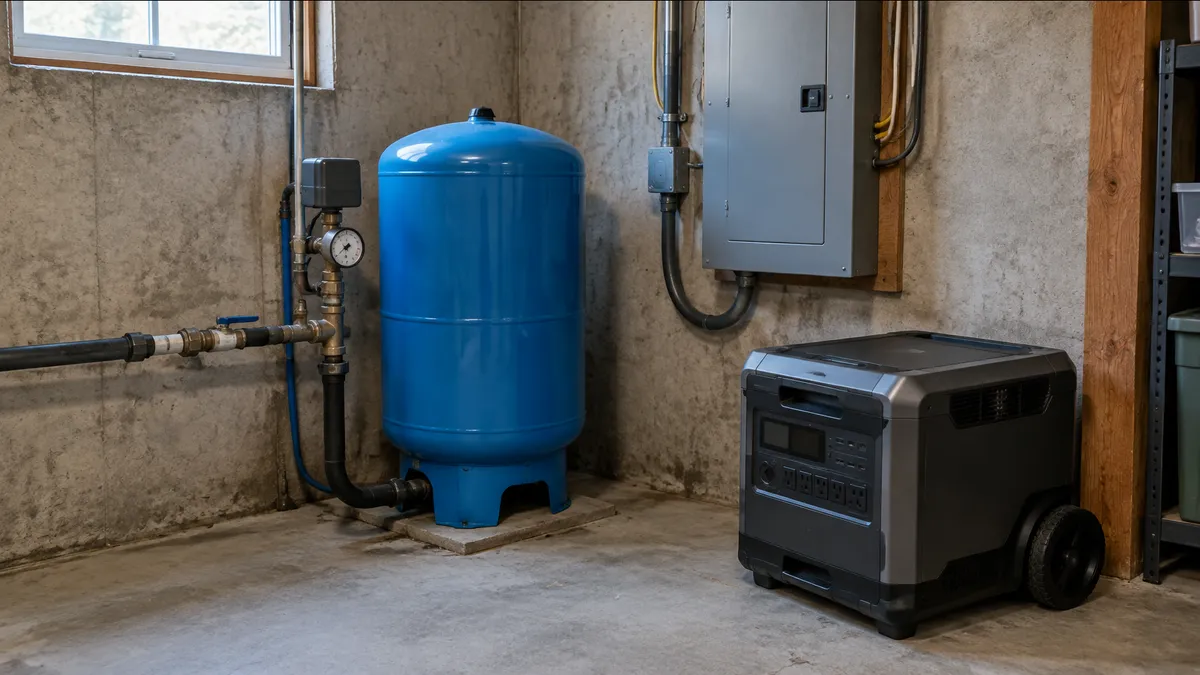
A deep-well pump is the hardest common load to run from a battery. Running watts are modest — about 670 W for a 1/2 HP Franklin motor and 1,210 W for 1 HP — but most are 240 V motors that draw locked-rotor amps at start-up, and most portable stations cannot output 240 V at all. On Franklin's published numbers, the Anker SOLIX F3800 (9,000 W surge, about 37.5 A at 240 V) can attempt a 1/2 HP or 3/4 HP 3-wire pump, the EcoFlow DELTA Pro 3 (8,000 W, about 33.3 A) clears a 1/2 HP 3-wire pump, and neither clears a standard 1 HP motor with margin. A soft-start pump such as the Grundfos SQ changes that math. Our recommendation: confirm your motor's HP, wiring and locked-rotor amps before you spend $2,000+, have an electrician install an inlet and interlock, and test the start before the outage.
Identify your pump before you shop
Three facts decide whether any battery can start your pump, and you can get all three without pulling the pump out of the well:
- Voltage. A double-pole breaker (two handles tied together) in your panel labeled well or pump means a 230/240 V motor. A single-pole 15 or 20 A breaker usually means 115 V. Most residential submersibles from 3/4 HP up are 230 V.
- Horsepower and 2-wire vs 3-wire. A 3-wire pump has a gray control box near the pressure tank or panel with the HP printed on the label; the start capacitor and relay live there. A 2-wire pump has no control box, because the start parts are inside the motor. If there is no box, look for the pump card the driller left, the well log, or a label on the pressure switch cover.
- Locked-rotor amps (LRA) or soft-start. The motor nameplate is down the well, so use the maker's motor table for the model on the control box or invoice. If the pump is a Grundfos SQ/SQE or uses a variable-speed constant-pressure controller, it soft-starts and the problem shrinks a lot.
If you have a shallow-well or convertible jet pump above ground, the nameplate is on the motor itself. Read it directly; many are 115/230 V switchable. Our sump pump guide covers the smaller 120 V motors.
Starting amps vs station surge: the one comparison that matters
An induction motor at rest looks almost like a short circuit. Until the rotor spins up, it pulls its locked-rotor current — several times its running current — for a fraction of a second to about a second. A generator handles that by letting the voltage sag and recovering; Franklin's AIM manual says a generator must hold at least 65% of rated voltage during the start. An inverter handles it by current-limiting and, if the motor does not come up fast enough, tripping on overload.
Stations publish surge in watts. To compare it with a motor table, divide by the output voltage: 8,000 W ÷ 240 V ≈ 33.3 A for the EcoFlow DELTA Pro 3 and 9,000 W ÷ 240 V = 37.5 A for the Anker SOLIX F3800. Then compare that with the motor's locked-rotor amps. This is a paper check: it treats surge watts as volt-amps, ignores how long each inverter holds surge, and uses Franklin's 230 V LRA (a motor fed 240 V pulls a few percent more). It is still the best way to rule a station in or out before you buy one.
Running watts are rarely the limit. A 1 HP Franklin motor at full load is 1,210 W and 1,600 W at its maximum service-factor load, well inside any 240 V station. The start is what decides it.
Franklin 4-inch motors vs the two 240 V stations
| Motor | Franklin model | Full-load W | Max-load W | Locked-rotor A | EcoFlow DELTA Pro 3 (~33.3 A) | Anker SOLIX F3800 (~37.5 A) |
|---|---|---|---|---|---|---|
| 1/2 HP 3-wire, 230 V | 214505 | 670 | 960 | 23.0 | Clears on paper (1.45×) | Clears on paper (1.63×) |
| 1/2 HP 2-wire, 230 V | 244505 | 670 | 960 | 32.2 | Thin margin (1.04×) | Clears on paper (1.16×) |
| 3/4 HP 3-wire, 230 V | 214507 | 940 | 1,310 | 34.2 | Borderline (0.97×) | Thin margin (1.10×) |
| 3/4 HP 2-wire, 230 V | 244507 | 940 | 1,310 | 40.7 | Short (0.82×) | Borderline (0.92×) |
| 1 HP 3-wire, 230 V | 214508 | 1,210 | 1,600 | 41.8 | Short (0.80×) | Borderline (0.90×) |
| 1 HP 2-wire, 230 V | 244508 | 1,210 | 1,600 | 48.7 | Short (0.68×) | Short (0.77×) |
| 1.5 HP 3-wire, 230 V | 224300 | 1,620 | 2,080 | 51.4 | Short (0.65×) | Short (0.73×) |
| 1.5 HP 2-wire, 230 V | 244309 | 1,710 | 2,280 | 66.2 | Short (0.50×) | Short (0.57×) |
Read the table this way: a 1/2 HP 3-wire pump is comfortable on both. A 3/4 HP 3-wire pump is the dividing line — the F3800 has a little margin, the DELTA Pro 3 sits just under. From 1 HP up, the DELTA Pro 3 falls short on paper and the F3800 is borderline at best (1 HP 3-wire) or short (1 HP 2-wire), and 2-wire motors are always the harder case because they need more current at the same horsepower.
EcoFlow's well-pump guide says the DELTA Pro 3's 8,000 W surge "can cover" the inrush of a 1 HP pump. Some inverters do start motors above the paper number, because a stiff inverter lets the motor accelerate faster than a sagging generator would. We have no test result for either station on a 1 HP submersible, so we do not recommend buying one for that job on the strength of a marketing line. If you already own one, test it (see wiring), and send us the result.
115 V pumps and ordinary 120 V stations
Some 1/2 HP submersibles and many jet pumps are 115 V. Those can run from a 120 V station, but the locked-rotor current is twice as high as the 230 V version of the same motor, because the power is the same at half the voltage. Here is the paper check against 120 V stations that publish a motor surge rating:
| Station | Continuous W | Surge W | Surge A at 120 V | 1/2 HP 3-wire (50.5 A) | 1/2 HP 2-wire (64.4 A) |
|---|---|---|---|---|---|
| EcoFlow DELTA Pro 3 | 4,000 | 8,000 | 66.7 | Clears on paper (1.32×) | Thin margin (1.04×) |
| BLUETTI AC200L | 2,400 | 7,200 | 60.0 | Clears on paper (1.19×) | Borderline (0.93×) |
| Jackery Explorer 2000 Plus | 3,000 | 6,000 | 50.0 | Borderline (0.99×) | Short (0.78×) |
| EcoFlow DELTA 2 Max | 2,400 | 4,800 | 40.0 | Short (0.79×) | Short (0.62×) |
| Jackery Explorer 2000 v2 | 2,200 | 4,400 | 36.7 | Short (0.73×) | Short (0.57×) |
| Jackery Explorer 1000 Plus | 2,000 | 4,000 | 33.3 | Short (0.66×) | Short (0.52×) |
Only the biggest packs clear a 115 V 3-wire 1/2 HP pump on paper, and a 115 V 2-wire pump is marginal on everything. If you are replacing a pump anyway, ask the installer about a 230 V or soft-start model; it makes every backup option easier.
Soft-start pumps change the answer
Grundfos's SQ/SQE installation instructions describe a built-in soft starter and a motor with a power factor of 1, sold in 115 V and 230 V versions. Grundfos publishes its own generator sizing: a minimum of the motor input power (P1) plus 10% and a recommended P1 plus 50%. That is a very different scale from Franklin's across-the-line motors:
| SQ motor | Minimum generator (P1 + 10%) | Recommended (P1 + 50%) | Fits within |
|---|---|---|---|
| 0.5 HP | 1,200 W | 1,500 W | DELTA Pro 3 (4,000 W continuous) and F3800 (6,000 W) |
| 0.75 HP | 1,900 W | 2,500 W | DELTA Pro 3 (4,000 W continuous) and F3800 (6,000 W) |
| 1.0 HP | 2,600 W | 3,200 W | DELTA Pro 3 (4,000 W continuous) and F3800 (6,000 W) |
| 1.5 HP | 2,800 W | 3,500 W | DELTA Pro 3 (4,000 W continuous) and F3800 (6,000 W) |
Every SQ size up to 1.5 HP sits inside the DELTA Pro 3's continuous rating even at the recommended figure. Variable-speed constant-pressure systems from other makers also ramp the motor up instead of slamming it on; check that model's generator or inverter guidance. If your well contractor is quoting a replacement, a soft-start pump is the single best upgrade for battery backup.
How many days of water a charge gives you
Once the pump starts, energy is simple. We use our standard rule — usable energy = nameplate Wh × 0.85, and about 15 W of inverter idle whenever the AC output is on — plus three inputs: Franklin's full-load watts, an assumed 10 gallons per minute (check your pump curve; deep wells deliver less), and EPA's figure that the average American family uses more than 300 gallons a day at home.
| Scenario | Wh per day | EcoFlow DELTA Pro 3 (4,096 Wh) | Anker SOLIX F3800 (3,840 Wh) |
|---|---|---|---|
| 1/2 HP, normal family use, AC left on 24 h | 695 | 5.0 days | 4.7 days |
| 1 HP, normal family use, AC left on 24 h | 965 | 3.6 days | 3.4 days |
| 1 HP, outage rationing (100 gal), AC left on 24 h | 562 | 6.2 days | 5.8 days |
| 1 HP, rationing, AC on only 2 h a day (batched) | 232 | 15.0 days | 14.1 days |
| 1/2 HP, rationing, AC on only 2 h a day (batched) | 142 | 24.6 days | 23.0 days |
The surprise is the idle drain: 15 W × 24 hours = 360 Wh a day, more than the pump itself uses for 100 gallons. During a long outage, batch your water use — fill a few buckets and the pressure tank, run laundry or showers in one window, then turn the AC output off. In the table that takes a 1 HP household from about 6 days to about 15 on the same pack. Solar input helps too: see our home backup guide for panel and battery-expansion options.
Your pressure tank decides how many starts you need
Every time the pressure switch closes, the station has to survive another start. Fewer, longer runs are easier on the inverter and the motor. Amtrol's Well-X-Trol spec card lists drawdown by pressure setting; Amtrol sizes tanks for about one minute of pump run time per cycle for pumps up to 3/4 HP and two minutes above that.
| Tank | 30/50 psi | 40/60 psi | 50/70 psi | Starts for 300 gal at 40/60 |
|---|---|---|---|---|
| Amtrol WX-202 (20 gal class) | 6.2 gal | 5.4 gal | 4.7 gal | about 56 |
| Amtrol WX-250 (44 gal class) | 13.6 gal | 11.8 gal | 10.4 gal | about 25 |
A small tank on a household of four can mean 50+ starts a day. If your pump is borderline on starting current, a larger tank does not make any single start easier, but it cuts the number of chances to trip and is cheap insurance against short-cycling. Check the tank's air precharge (usually 2 psi below the cut-in pressure) while you are at it.
Wiring it safely and testing it
- Use a proper inlet and interlock or transfer switch. Franklin's manual warns that transfer switches must be used whenever a generator backs up utility lines; the same applies to a battery inverter. A licensed electrician can add a power inlet (L14-30 is common) and an interlock so the main breaker and the backup feed can never be on at the same time. Never backfeed with a double-male cord.
- Know the 240 V quirks. EcoFlow's DELTA Pro 3 FAQ says the unit outputs either 120 V or 240 V, not both: in 240 V mode the L14-30 and 6-20 outlets are live and the 120 V outlets are off. On a panel interlock, 240 V mode still powers 120 V circuits on both legs. Anker's F3800 product page — which now shows the F3800 Plus — notes that 240 V output is unavailable while the unit is charging from a 120 V AC source.
- Turn off everything else before the first start. Shed the fridge, furnace blower and microwave so the full surge is available to the pump. Once it is running, bring other loads back on.
- Test before the storm. With utility power off at the main and the station feeding the panel, open a tap until the pressure switch clicks. Watch the station display: a clean start shows a brief spike and steady watts near the motor's full-load figure. An overload trip or the pump humming without building pressure means the station cannot start it. Do not retry repeatedly; a stalled motor heats fast.
- Check auto-off settings. Some stations turn the AC output off after a period with low load. A pump that waits for the pressure switch looks like no load; set AC timeout to never during an outage.
Alternatives when the station cannot start the pump
- A 120/240 V generator. Franklin's minimums for an externally regulated generator are 2 kW for 1/2 HP, 3 kW for 3/4 HP, 4 kW for 1 HP and 5 kW for 1.5 HP, with 50% more for 2-wire motors (so 6 kW for a 1 HP 2-wire). Our generator sizing guide covers whole-house loads. Run it outdoors, at least 20 feet from doors, windows and vents (CDC).
- Hybrid: generator for the pump, station for everything else. Run the generator for 30 minutes to refill the tank and buckets, then shut it down and live on the station. This is the cheapest way to keep a 1 HP pump going without a whole-home battery.
- Replace with a soft-start pump. When the old pump is due, a soft-start or variable-speed model brings a 1 HP well within the range of a 4 kW inverter.
- Store water. One gallon per person per day for drinking and cooking, plus buckets for flushing, covers a short outage with no pump at all.
- Whole-home battery systems. Permanently installed home batteries have larger inverters and are sized by an installer for motor loads; see SolarSized for battery sizing.
Our picks
3/4 HP 3-wire or 1/2 HP 2-wire 240 V pump: Anker SOLIX F3800
The highest surge current in our set (37.5 A at 240 V) and 6,000 W continuous, with L14-30 and 14-50 outputs. It is the only station here with margin over a 3/4 HP 3-wire Franklin motor on paper. Anker's F3800 URL now shows the F3800 Plus ($2,999.99, still sold out on November 11, 2026; differences in our F3800 vs F3800 Plus guide); check whether the F3800 Plus or remaining F3800 stock is available before planning around it.
Check price on Amazon1/2 HP 3-wire or any soft-start pump: EcoFlow DELTA Pro 3
4,000 W continuous, 8,000 W surge (about 33.3 A at 240 V), switchable 120/240 V with an L14-30 outlet, and 4,096 Wh that expands with extra batteries. It clears a 1/2 HP 3-wire pump with margin and every Grundfos SQ size at the recommended rating. EcoFlow listed $2,799 (compare-at $3,299) on November 10, 2026, with the standalone unit marked unavailable.
Check price on Amazon1 HP or larger hard-start pump: a 120/240 V generator
Neither station clears a standard 1 HP motor on paper. Size the generator to Franklin's table (4 kW for a 1 HP 3-wire, 6 kW for 2-wire) and pair it with a smaller station for quiet overnight loads. Our generator guide compares models.
Check price on AmazonAs an Amazon Associate we earn from qualifying purchases. Prices and stock change; the figures above were checked on maker sites on November 10, 2026.
Related
- Anker F3800 Plus vs EcoFlow DELTA Pro 3 (240 V output, surge amps, idle draw)
- Best power station for a sump pump
- Best power station for home backup
- What size generator for a house
- 3-day outage plan
- All “best power station for” guides
Sources
- Franklin Electric AIM manual, 2023 edition: 4-inch single-phase motor specifications (full-load and maximum-load amps and watts, locked-rotor amps), engine-driven generator minimum ratings (2-wire motors +50%; 65% voltage during start), and the transfer-switch warning
- Grundfos SQ/SQE installation and operating instructions: built-in soft start, power factor 1, 115 V and 230 V versions, generator sizing P1 + 10% minimum and P1 + 50% recommended
- Amtrol Well-X-Trol specification card: drawdown at 30/50, 40/60 and 50/70 psi; sizing for about 1 minute of run time up to 3/4 HP and 2 minutes above
- U.S. EPA WaterSense, How We Use Water: the average American family uses more than 300 gallons a day at home
- EcoFlow DELTA Pro 3 product page: 4,000 W continuous, 8,000 W surge, 120/240 V; $2,799 (compare-at $3,299), standalone unit listed unavailable on November 10, 2026
- EcoFlow DELTA Pro 3 FAQ: 120 V or 240 V output, not both at once; L14-30 and 6-20 outlets in 240 V mode
- EcoFlow blog, Generator for Well Pump: claims the DELTA Pro 3 surge covers a 1 HP pump's inrush (maker claim, not verified here)
- Anker SOLIX F3800 product URL (now the F3800 Plus page, sold out, November 10, 2026): 240 V output unavailable while charging from 120 V AC
- CDC: carbon monoxide basics — run generators outdoors, more than 20 feet from windows, doors and vents
- Station capacity, continuous and surge watts come from the source on each station page and stations.json. Method: methodology.
Questions
Can a portable power station run a well pump?
Sometimes. A shallow-well jet pump or a 1/2 HP submersible on 120 V can run from several large stations; a 240 V submersible needs a station with a native 240 V output, such as the EcoFlow DELTA Pro 3 or Anker SOLIX F3800, and enough surge current for the motor's start. Running watts are rarely the problem: Franklin lists 670 W at full load for a 1/2 HP motor and 1,210 W for 1 HP. Locked-rotor amps are. Check the pump nameplate or the control box label, and test before you rely on it.
Will a 120 V power station run my well pump?
Only if the pump motor is a 115 V model. Most residential submersibles over 1/2 HP are 230 V, and you cannot run a 230 V motor from a single 120 V outlet with an adapter. Look at the control box or breaker: a double-pole breaker (two handles tied together) means 240 V.
What size power station do I need for a 1 HP well pump?
On Franklin's table a 1 HP 3-wire motor draws 41.8 A locked-rotor at 230 V and a 1 HP 2-wire draws 48.7 A. Dividing published surge watts by 240 V gives about 33.3 A for the DELTA Pro 3 and 37.5 A for the F3800, so neither clears on paper. EcoFlow's own blog says the DELTA Pro 3's 8,000 W surge can cover a 1 HP pump's inrush; some inverters do start motors that exceed the paper number. Treat that as something to test with your pump, not something to plan around. Franklin's generator floor for a 1 HP 3-wire motor is 4 kW (6 kW for 2-wire), which a 120/240 V generator meets.
How many days of water will a full charge give me?
Using Franklin's 1,210 W full-load figure for 1 HP, 10 gallons per minute, EPA's 300 gallons a day for an average family and 15 W of inverter idle around the clock, a EcoFlow DELTA Pro 3 lasts about 3.6 days. Ration to 100 gallons and switch the AC output on only for a couple of hours a day and the same pack stretches to about 15 days. The pump is not the big drain when you ration; leaving the inverter on is.
What is the difference between a 2-wire and 3-wire well pump?
A 3-wire pump has a separate control box above ground (usually near the pressure tank) holding the start capacitor and relay. A 2-wire pump has those parts inside the motor and no control box. On Franklin's table, 2-wire motors draw more locked-rotor current at the same horsepower — 48.7 A vs 41.8 A at 1 HP — and Franklin says generators for 2-wire motors should be 50% larger.
Do I need a transfer switch to run a well pump from a power station?
Yes, if you are powering the pump circuit through the house wiring. Franklin's manual warns that transfer switches must be used whenever a generator backs up a utility line, and the same logic applies to a battery inverter. Have an electrician install an inlet with an interlock or a transfer switch. Never backfeed through a dryer outlet with a double-male cord.
Is a generator better than a power station for a well pump?
For a 1 HP or larger hard-start pump, usually yes, because it has more starting current and fuel is easy to store. Franklin's minimum for an externally regulated generator is 2 kW for 1/2 HP, 3 kW for 3/4 HP and 4 kW for 1 HP (50% more for 2-wire). A power station wins on silence and indoor use, and when the pump is small or soft-start. Run any generator outdoors and at least 20 feet from doors, windows and vents, per CDC.