Outage guide · Maker specs checked October 27, 2026
Can a power station run an oxygen concentrator? Runtimes from maker wattages
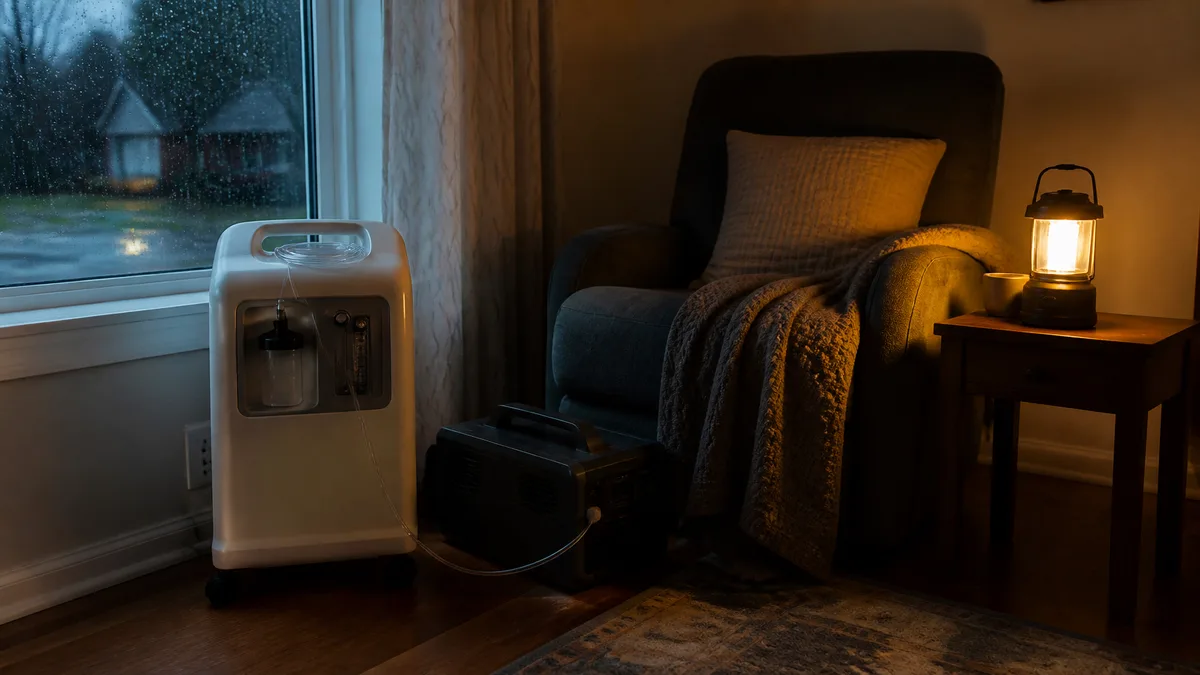
Yes, but for far less time than most people expect. A typical 5-liter home concentrator draws 275–350 W by its maker's own spec, so a 1 kWh station such as the Jackery Explorer 1000 v2 runs one for only about 2.5–3.1 hours. Treat a power station as a bridge that keeps oxygen flowing while you switch to the backup cylinders your supplier provides, not as your outage plan. Getting through an 8-hour night at 350 W takes about 3,435 Wh, which means a 4 kWh-class unit like the EcoFlow DELTA Pro 3. The exception is a low-draw unit at a low prescribed setting: the Inogen At Home at setting 2 is about 100 W, and a 2 kWh station covers that for roughly 15 hours.
Medical note. This page is general information about electricity, not medical advice. Your oxygen prescription, your doctor and your oxygen supplier decide your backup plan. Before an outage, ask your supplier for a backup supply that does not need electricity (cylinders) and learn how to switch to it, as the American Lung Association advises. Jackery says its power stations are not recommended for medical devices, and EcoFlow says its products are not intended for life-sustaining equipment. If you are short of breath or your oxygen is running out, call 911. Affiliate commissions have no bearing on any runtime or compatibility statement here; every figure comes from the device maker's published spec and the formula shown.
How many watts a home oxygen concentrator draws
A stationary concentrator runs a compressor all the time it is on, so it is one of the heaviest steady loads you can put on a portable power station and draws several times what a CPAP does. These are the makers' own figures for common 5-liter US models:
| Concentrator | Maker power figure | Flow | Warm-up after a restart | Used here |
|---|---|---|---|---|
| Inogen At Home (GS-100), setting 2 | About 100 W at flow setting 2 (Inogen product page) | 2 L/min | Under 5 minutes | 100 W |
| Inogen At Home (GS-100), setting 5 | 275 W max (user manual) | 5 L/min | Under 5 minutes | 275 W |
| DeVilbiss 525DS, 2.5 L/min and below | 275 W at 2.5 L/min and below (manual; the product page says 1.2 L/min and below) | ≤2.5 L/min | Not stated | 275 W |
| DeVilbiss 525DS, average | 310 W average; 115 V, 3.3 A rating | Up to 5 L/min | Not stated | 310 W |
| Invacare Perfecto2 V | 325 W typical; 120 V, 3 A rated input | 0.5–5 L/min | About 30 minutes to reach rated concentration | 325 W |
| Philips Respironics EverFlo | 350 W average (120 V models) | 0.5–5 L/min | Not stated | 350 W |
Two things stand out. Power depends on the setting, so ask your supplier for the figure at your prescribed flow, or measure it with a plug-in watt meter for an hour. And most makers publish only an average or typical number, not the start-up surge of the compressor. The nameplate current is a useful ceiling: 3 A at 120 V is 360 VA for the Invacare and 3.3 A at 115 V is about 380 VA for the DeVilbiss. Every station on this page is rated for 1,500 W continuous or more, so steady output is not the problem; battery size is.
The Inogen At Home manual also lists 275 W max; Inogen's 100 W figure is at setting 2. Philips lists lower figures for 220–230 V models; this page uses the 120 V numbers.
Runtime by power station
| Station | Wh | AC out | Inogen At Home @2 (100 W) | 275 W (275 W) | DeVilbiss avg (310 W) | Perfecto2 V (325 W) | EverFlo (350 W) |
|---|---|---|---|---|---|---|---|
| Jackery Explorer 1000 v2 | 1,070 | 1,500 W | 7.9 h | 3.1 h | 2.8 h | 2.7 h | 2.5 h |
| Anker SOLIX C1000 | 1,056 | 1,800 W | 7.8 h | 3.1 h | 2.8 h | 2.6 h | 2.5 h |
| EcoFlow DELTA 2 Max | 2,048 | 2,400 W | 15.1 h | 6.0 h | 5.4 h | 5.1 h | 4.8 h |
| Jackery Explorer 2000 Plus | 2,043 | 3,000 W | 15.1 h | 6.0 h | 5.3 h | 5.1 h | 4.8 h |
| BLUETTI AC200L | 2,048 | 2,400 W | 15.1 h | 6.0 h | 5.4 h | 5.1 h | 4.8 h |
| Anker SOLIX F3800 | 3,840 | 6,000 W | 23.3 h | 10.4 h | 9.3 h | 8.9 h | 8.4 h |
| EcoFlow DELTA Pro 3 | 4,096 | 4,000 W | 30.3 h | 12.0 h | 10.7 h | 10.2 h | 9.5 h |
Anker SOLIX F3800 row: hours use about 40 W of idle draw instead of 15 W, because Anker's FAQ for the F3800 Plus lists about 40 W with AC on and nothing connected (Anker; F3800 idle table).
The 0.85 factor is our allowance for inverter and conversion losses, and the 15 W is the inverter's own draw (the figure BLUETTI publishes for its AC180); see the methodology. Real runtimes will be shorter in a cold room, on an older battery, or if the station also powers lights or a phone charger. A station's published watt-hours are its battery size, not the energy you get at the outlet.
What it takes to get through a night
| Concentrator draw | 4 hours | 8 hours | 24 hours |
|---|---|---|---|
| 100 W (Inogen At Home @2) | 541 Wh | 1,082 Wh | 3,247 Wh |
| 275 W | 1,365 Wh | 2,729 Wh | 8,188 Wh |
| 310 W (DeVilbiss avg) | 1,529 Wh | 3,059 Wh | 9,176 Wh |
| 325 W (Perfecto2 V) | 1,600 Wh | 3,200 Wh | 9,600 Wh |
| 350 W (EverFlo) | 1,718 Wh | 3,435 Wh | 10,306 Wh |
At 300–350 W, 24 hours is roughly 9–10 kWh, the size of a home battery wall or several of the largest portable stations. That is why a battery alone is not a multi-day oxygen plan. Over a long outage, the options that scale are your supplier's cylinders, a generator running outdoors to recharge the station (see what size generator and generator vs power station), or going somewhere with power. Solar helps but is slow: a 400 W panel array on a good winter day harvests well under one night's energy for a 350 W concentrator. Our 3-day outage planner shows the full budget for a household.
Switchover and restart
When the wall power drops, a concentrator stops and sounds its power-failure alarm. A power station in pass-through or UPS mode can keep it running without a gap, which matters because some units take time to come back to full purity: Invacare says the Perfecto2 V reaches its rated concentration after about 30 minutes of warm-up, and Inogen says under 5 minutes for the At Home.
| Station | Published switchover |
|---|---|
| Jackery Explorer 1000 v2 | <20 ms |
| Anker SOLIX C1000 | <20 ms |
| EcoFlow DELTA 2 Max | Not verified for this page |
| Jackery Explorer 2000 Plus | 20 ms (EPS) |
| BLUETTI AC200L | Not verified for this page |
| Anker SOLIX F3800 | Not verified for this page |
| EcoFlow DELTA Pro 3 | 10 ms |
Test before you need it: with the concentrator running from the station and the station plugged into the wall, unplug the station and listen. No alarm and no restart means the switchover works for your unit. Also turn off any energy-saving or AC auto-off timer (Jackery ships the 1000 v2 with Energy Saving Mode on), and check that the station's fan noise and the concentrator's exhaust have room to breathe; Inogen asks for at least 6 inches of clearance and Invacare 12 inches.
Portable oxygen concentrators (POCs)
A POC is the easier load. It has its own battery (Inogen rates the One G5 at up to 6.5 hours on the single battery and 13 hours on the double, depending on setting) and can be charged from a power station. Two cautions from the Inogen One G5 manual:
- DC voltage. The G5's DC cable expects 13.5–15.0 V at up to 10 A. The 12 V car ports on the stations we track are listed at 12 V, below that range, so plan on the AC power supply in an AC outlet unless your station maker publishes a car-port voltage inside it.
- No published watts. Inogen lists the AC supply's input current (2.0–1.0 A), not average power. Measure your POC with a plug-in watt meter while it runs at your setting and charges a battery, then use the runtime formula above.
Spare charged POC batteries and a car charger are on the American Lung Association's outage checklist; they cost less than a big station and don't depend on an inverter.
A realistic outage plan
- Get a non-electric backup. Ask your oxygen supplier for cylinders sized to your prescription and how many hours each lasts. Learn to connect one before you need it.
- Register as power-dependent. Tell your electric utility, and local fire and police, that you rely on home oxygen; many utilities run a medical-priority program.
- Size the battery as a bridge. Pick a station that covers at least the time it takes to switch to cylinders or reach help, using the tables above with your unit's real draw.
- Plan the recharge. A generator outdoors, never in a garage or near a window, or a place with power. Carbon monoxide is a bigger risk than a dead battery.
- Don't turn the flow down to stretch the battery unless your doctor tells you to.
- Test twice a year: full charge, real unplug test, and a timed run so you know your actual hours.
Our picks
Bridge to your backup cylinders
1,070 Wh · 1,500 W · 23.8 lb · switchover <20 ms
The bridge. 1,070 Wh, 1,500 W continuous and a <20 ms switchover in a 23.8 lb box you can carry. About 2.7 hours on a 325 W concentrator, or about 8 hours on an Inogen At Home at setting 2.
Overnight at about 100 W
2,043 Wh · 3,000 W · 61.5 lb · switchover 20 ms (EPS)
The overnight pick for low-draw units. 2,042.8 Wh, 3,000 W and a 20 ms EPS. About 15 hours at 100 W, but only 4.8 hours on a 350 W EverFlo. 61.5 lb, so it lives in one place.
Overnight at 300–350 W
4,096 Wh · 4,000 W · 113.54 lb · switchover 10 ms
The one that gets a full-power 5 L concentrator through a night. 4,096 Wh, 4,000 W and a 10 ms UPS: about 9.5 hours at 350 W. At 113.5 lb it is a wheeled unit, and it costs far more than cylinders.
As an Amazon Associate we earn from qualifying purchases. Picks are ranked on watt-hours and published switchover only; we did not test these stations with a concentrator, and we received nothing from any brand. Switchover times are from the Jackery 2000 Plus, EcoFlow DELTA Pro 3, Jackery 1000 v2 and Anker C1000 pages.
Skip: any station under about 1 kWh for a stationary concentrator. A 768 Wh unit lasts about two hours at 300 W and buys you little over a cylinder.
Related guides
- Best power station for a CPAP
- BiPAP battery backup
- Best power station for home backup
- 3-day power outage plan
- Generator vs power station
- All guides
Sources
- Philips Respironics EverFlo brochure (350 W average, 120 V)
- Philips Respironics EverFlo user manual (power by model)
- Invacare Perfecto2 V user manual (325 W typical, 3 A, warm-up, not life-supporting, no extension cords)
- Drive DeVilbiss 5 Liter (525DS) product page (310 W average)
- DeVilbiss 525DS user manual (275 W at 2.5 L/min and below, 3.3 A)
- Inogen At Home product page (100 W at setting 2)
- Inogen At Home user manual (275 W max, warm-up, clearance)
- Inogen One G5 user manual (DC input, battery duration)
- American Lung Association: power outages and lung health
- Jackery Explorer 1000 v2 (UPS, medical-device statement)
- Jackery Explorer 2000 Plus (20 ms EPS)
- EcoFlow DELTA Pro 3 (10 ms UPS)
- Anker SOLIX C1000
- EcoFlow safety instructions (life-sustaining equipment)
- Station capacity, output and weight come from the source on each station page. Method: methodology.
Questions
How long will a power station run an oxygen concentrator?
Divide the station's watt-hours by the concentrator's watts, after allowing for losses. We use Wh × 0.85 ÷ (concentrator watts + 15 W inverter draw). A 1,070 Wh Jackery Explorer 1000 v2 runs a 350 W Philips EverFlo about 2.5 hours and an Inogen At Home at setting 2 (about 100 W) about 7.9 hours. A 4,096 Wh EcoFlow DELTA Pro 3 runs the same units about 9.5 and 30.3 hours.
What size power station do I need for an oxygen concentrator overnight?
For 8 hours, multiply (watts + 15) by 8 and divide by 0.85. That is about 3,435 Wh for a 350 W EverFlo, 3,200 Wh for a 325 W Invacare Perfecto2 V, 2,729 Wh for a concentrator at 275 W and 1,082 Wh for an Inogen At Home at setting 2. Use your own unit's spec at your prescribed flow, and add margin because batteries lose capacity in the cold and with age.
Can I run an oxygen concentrator from a 1,000 Wh power station?
Yes, for a few hours. Every 1 kWh-class station we list has enough continuous output (1,500 W or more), but at 275–350 W the battery is empty in about 2.5–3.1 hours. That is a useful bridge while you change over to cylinders or get to a place with power, not an overnight plan.
Will a power station run a portable oxygen concentrator (POC)?
Usually yes, through the POC's own AC power supply. Check the DC route first: the Inogen One G5 manual lists a DC input of 13.5–15.0 V, while the car ports on the stations we track are listed as 12 V. Use the maker's AC adapter in an AC outlet unless your station maker publishes a car-port voltage inside your POC's range. Inogen rates the G5 at up to 6.5 hours on a single battery and 13 hours on a double, depending on setting.
Should I lower my oxygen flow to make the battery last longer?
No, not without your doctor. The American Lung Association says not to reduce your oxygen flow rate to stretch a battery or oxygen supply without talking to your healthcare provider.
Is a power station safe for medical equipment?
Some makers say no. Jackery says its power stations are not recommended for medical devices, EcoFlow says its products are not intended for life-sustaining equipment, and Invacare describes the Perfecto2 V as not intended to sustain or support life. Ask your doctor and equipment supplier before you rely on any battery, and keep a non-electric backup oxygen supply.
Keeping insulin cold? Power station for an insulin fridge covers the FDA 28-day rule, 12 V cooler vs mini fridge runtime and days by station.