Outage guide · FDA guidance and maker specs checked October 28, 2026
Power station for an insulin fridge: how many days you really get
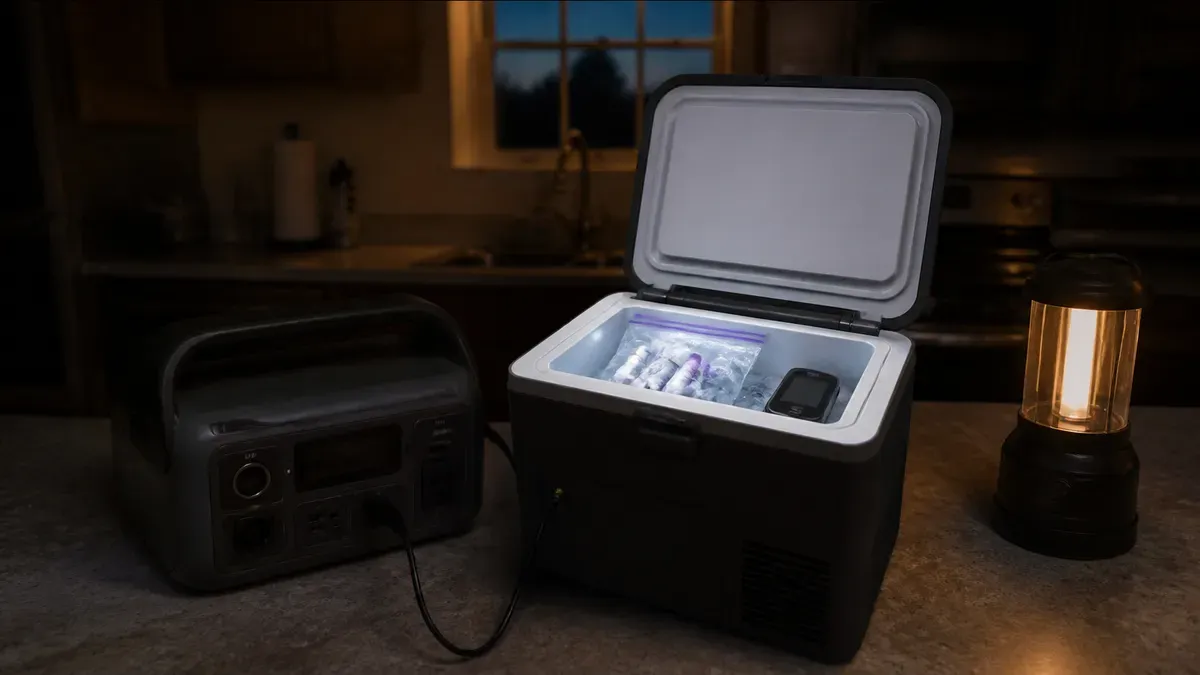
Start with the FDA's rule, not the battery. Insulin in its original vial or cartridge, opened or unopened, can stay unrefrigerated at 59°F to 86°F for up to 28 days and keep working. In a mild-weather outage you may not need power for insulin at all. Power matters when the room gets hotter than 86°F, when you are protecting a supply of unopened insulin, or when the outage runs long. Then the efficient setup is a small 12 V compressor cooler on the station's car outlet: Dometic rates its CFX3 25 at 0.92 Ah per hour at 12 V in 90°F heat, about 11 W, so a 1,070 Wh Jackery Explorer 1000 v2 runs it about 82 hours (3.4 days). A plug-in compact fridge on AC averages 25–28 W by Danby's figures plus about 15 W of inverter draw, which cuts that to about 21–23 hours.
Medical note. This page is general information about electricity and storage, not medical advice. Your insulin's label, your pharmacist and your doctor decide how to store and use it. Storage rules differ between products, so check the leaflet for yours. The FDA lists a customer-service number for every US insulin maker if you are unsure whether insulin exposed to heat or cold is still usable. If you have symptoms of high or low blood sugar you cannot manage, or you run out of insulin, call 911 or go to an emergency room. Affiliate commissions have no bearing on any storage or runtime statement here; every figure comes from the FDA, the device maker's published spec and the formula shown.
What the FDA says about insulin without a fridge
The FDA's emergency insulin guidance is the starting point, because it changes how big a battery you need:
| Situation | FDA guidance |
|---|---|
| Normal storage | Refrigerate at about 36°F to 46°F. Unopened and stored this way, insulin keeps until its expiration date. |
| No refrigerator | Vials or cartridges from the maker, opened or unopened, may be left unrefrigerated at 59°F to 86°F for up to 28 days and continue to work. |
| Diluted or drawn out of the original vial | Throw away within two weeks. |
| Above 86°F | Heat makes insulin less effective, and the longer the exposure the bigger the loss. In an emergency you may still need to use it. Keep it as cool as possible and replace it when you can. |
| Ice | Avoid freezing. Do not use insulin that has been frozen. |
| Awiqli (once-weekly) | Room temperature below 86°F for up to 12 weeks total. |
| Insulin pump | Reservoir and tubing insulin generally replaced after 48 hours unless the product and pump instructions say otherwise. Throw it away if exposed to more than 98.6°F. |
General outage advice from Ready.gov is to throw out refrigerated medication after the power has been out for more than a day unless the label says otherwise. Insulin labels usually do say otherwise, which is why the 28-day room-temperature window matters. Time out of the fridge counts against that window, so note the date you took each vial or pen out.
When you actually need power
- Summer outages and hurricanes. A house without air conditioning can pass 86°F quickly. This is the main reason to keep insulin refrigerated through an outage.
- A stock of unopened insulin. Kept refrigerated, it lasts to its expiration date. Left out, each vial or pen starts its 28-day clock (or the period on its label).
- Long outages. After a multi-day storm, refrigerated insulin is the stock you can count on when the outage ends.
- Cold rooms. In winter the risk flips: a cold garage, car or room can freeze insulin. A cooler on battery can hold a steady temperature either way.
None of this needs a full-size fridge. A day or two of insulin fits in a few inches of shelf space, which is why a small cooler is the efficient answer. If you also want to save food, size for the kitchen fridge instead; see the fridge guide.
How much power a small fridge uses
Compressor fridges cycle on and off, so the useful number is average draw, not the nameplate. These are the makers' own figures:
| Unit | Maker figure | Average draw | Connects to the station by |
|---|---|---|---|
| Dometic CFX3 25 (25 L 12 V compressor cooler) | 0.92 Ah/h at 12 V DC, set to 39°F in 90°F ambient; 6.5 A rated at 12 V | About 11 W | 12 V car outlet (no inverter) |
| Danby DCR032C1WDB (3.2 cu ft compact fridge) | 115 V, 66.4 W, 218 kWh/year | 24.9 W | AC outlet (inverter on) |
| Danby DAR010A1BDB (1.0 cu ft compact fridge) | 115 V, 90 W, 241 kWh/year | 27.5 W | AC outlet (inverter on) |
Two things to notice. Dometic's figure is a hot-room test, 90°F around the cooler, so in a 75°F house it should use less. The Danby figures are annual ratings divided by 8,760 hours, measured under the standard test, not in a heat wave. And on AC the station's inverter adds its own draw. We use 15 W, the figure BLUETTI publishes for its AC180, which is more than a small cooler uses by itself. The cooler's 6.5 A rating at 12 V is also well inside the 10 A car ports Jackery and Anker list.
Hours by power station
| Station | Wh | Car outlet | Dometic CFX3 25 on 12 V | Danby 3.2 cu ft on AC | Danby 1.0 cu ft on AC |
|---|---|---|---|---|---|
| Anker SOLIX C800 | 768 | 12 V/10 A | 59 h (2.5 days) | 16 h | 15 h |
| BLUETTI AC70 | 768 | 12 V | 59 h (2.5 days) | 16 h | 15 h |
| Jackery Explorer 1000 v2 | 1,070 | 12 V/10 A | 82 h (3.4 days) | 23 h | 21 h |
| Anker SOLIX C1000 | 1,056 | 12 V/10 A | 81 h (3.4 days) | 22 h | 21 h |
| EcoFlow DELTA 3 Plus | 1,024 | Yes | 79 h (3.3 days) | 22 h | 20 h |
| Jackery Explorer 2000 Plus | 2,043 | 12 V/10 A | 157 h (6.6 days) | 44 h | 41 h |
| EcoFlow DELTA 2 Max | 2,048 | 126 W | 158 h (6.6 days) | 44 h | 41 h |
| EcoFlow RIVER 3 Plus | 286 | 126 W | 22 h | 6 h | 6 h |
The DC column is the headline: skipping the inverter roughly triples or quadruples runtime. Check that your station's car outlet stays on with a small load, because some stations switch off idle ports after a timeout. Test it at home before you need it. Real runtime will be shorter on an older battery, in a cold room, or if the station also charges phones. See the methodology.
Watt-hours for 1, 3 and 7 days
| Setup | 1 day | 3 days | 7 days |
|---|---|---|---|
| Dometic CFX3 25 on 12 V (about 11 W) | 312 Wh | 935 Wh | 2,182 Wh |
| Danby 3.2 cu ft on AC (24.9 W + 15 W) | 1,127 Wh | 3,380 Wh | 7,886 Wh |
| Danby 1.0 cu ft on AC (27.5 W + 15 W) | 1,200 Wh | 3,600 Wh | 8,400 Wh |
For a week, even the cooler needs about 2,182 Wh, so plan to recharge. A generator run outdoors for an hour or two a day, a car with the engine running outside, or solar panels can all top the station up. Never run a generator or car in a garage or near a window: carbon monoxide is a bigger danger than warm insulin. See the 3-day outage plan for a whole-house version.
Setup that keeps insulin safe
- Set it to 39°F, Dometic's recommended refrigeration setting, inside the FDA's 36°F to 46°F range.
- Use a separate thermometer next to the insulin, ideally one that records minimum and maximum. Small fridges and coolers can run colder near the cooling plate or back wall.
- Keep insulin off the cold surfaces. A sealed bag in a small box, not against the walls or the floor of the cooler.
- Open it as little as possible. Take out what you need for the day and keep in-use insulin at room temperature within the label's limits.
- Run it before the storm. Pre-cool the cooler on wall power so the battery only has to hold the temperature.
- Test it twice a year: full charge, cooler on the car outlet, and a timed run with the thermometer so you know your real hours.
Options that need no power
For in-use insulin, an evaporative cooling wallet is the cheapest backup. FRÍO says its wallet keeps insulin at 64.4°F to 78.8°F for at least 45 hours even at a constant 100°F, and can be reactivated in water every two days for up to a month. It is meant for in-use insulin and, in FRÍO's own words, is not a fridge alternative. A cooler with ice works too if the insulin is sealed and never touches the ice. A power station and cooler protect the unopened supply. A wallet protects the pen you carry.
Our picks
Two days on a 12 V cooler
768 Wh · 1,200 W · 23.1 lb · car port 12 V/10 A
The small one. 768 Wh and a 12 V/10 A car port in a 23.1 lb box. About 59 hours (2.5 days) with a Dometic CFX3 25 in a hot room.
Three days on a 12 V cooler
1,070 Wh · 1,500 W · 23.8 lb · car port 12 V/10 A
The three-day pick. 1,070 Wh and a 12 V/10 A car port. About 82 hours (3.4 days) on the cooler, or about 23 hours with a compact fridge on AC.
A week with recharging
2,043 Wh · 3,000 W · 61.5 lb · car port 12 V/10 A
For a week with a little recharging, or for a compact fridge on AC. 2,042.8 Wh and a 12 V/10 A car port: about 6.6 days on the cooler, 44 hours on a Danby 3.2 cu ft.
The cooler
Dometic CFX3 25
25 L · 12 V DC or 120 V AC · 0.92 Ah/h at 12 V (90°F room)
A compressor cooler with a digital thermostat that runs straight from a car outlet. Any 12 V compressor cooler with a published Ah/h figure can be sized the same way.
As an Amazon Associate we earn from qualifying purchases. Picks are ranked on watt-hours and a listed 12 V car outlet only. We did not test these stations with a cooler, and we received nothing from any brand. Car-port ratings come from each station's source on its station page.
Skip: stations without a car outlet for this job. The small EcoFlow RIVER 3 Plus does have one (12.6 V, 10 A, 126 W max per EcoFlow's spec sheet), but its 286 Wh only covers about 22 hours on DC, so treat it as an overnight bridge, not an outage plan. Also skip thermoelectric coolers, which cannot hold fridge temperature in a hot room.
Related guides
- Best power station for a fridge
- Best power station for a CPAP
- Power station for an oxygen concentrator
- 3-day power outage plan
- 24-hour outage plan
- All guides
Sources
- FDA: insulin storage and switching between products in an emergency
- Ready.gov: power outages (refrigerated medication)
- Dometic CFX3 25 specifications (0.92 Ah/h, rated current, recommended settings)
- Danby DCR032C1WDB (66.4 W, 218 kWh/year)
- Danby DAR010A1BDB (90 W, 241 kWh/year)
- FRÍO wallet (45 hours at 100°F)
- FRÍO FAQ (not a fridge alternative)
- CDC: carbon monoxide poisoning
- Station capacity, ports and weight come from the source on each station page. Method: methodology.
Questions
Does insulin need to be refrigerated during a power outage?
Not always. The FDA says insulin in the manufacturer's vials or cartridges, opened or unopened, may be left unrefrigerated at 59°F to 86°F for up to 28 days and continue to work. Keep it as cool as you can, out of direct sun and away from heat, and never let it freeze. Some products differ: Awiqli pens can stay at room temperature below 86°F for up to 12 weeks. Check your own product's label and ask your pharmacist.
How long will a power station run a mini fridge for insulin?
On AC, divide watt-hours × 0.85 by the fridge's average watts plus about 15 W of inverter draw. Danby's 1.0 cu ft DAR010A1BDB averages 27.5 W from its 241 kWh/year rating, so a 1,070 Wh Jackery Explorer 1000 v2 runs it about 21 hours and a 2,042.8 Wh Jackery Explorer 2000 Plus about 41 hours. A 12 V compressor cooler on the car outlet avoids the inverter and lasts about three to four times longer.
What size power station do I need to keep insulin cold for 3 days?
About 935 Wh for a Dometic CFX3 25 on the 12 V car outlet in 90°F heat, using Dometic's 0.92 Ah/h figure, or about 3,380–3,600 Wh for a Danby compact fridge on AC. A 1 kWh station covers three days on DC in a hot room only with almost no margin, so a 2 kWh station or a way to recharge is the safer plan.
Is a 12 V cooler or a mini fridge better for insulin on battery?
For battery runtime, the 12 V compressor cooler. It runs straight from the station's car outlet without the inverter, and it has a digital thermostat you can set. A plug-in compact fridge costs less but runs through the inverter, which adds roughly 15 W around the clock on top of the fridge itself. Avoid thermoelectric (Peltier) coolers, which can only cool to a set number of degrees below room temperature.
Can I keep insulin on ice instead?
Yes, with care. The FDA says to avoid freezing insulin if you use ice and not to use insulin that has been frozen. Keep the insulin in a sealed bag, wrapped, so it never touches ice directly. An evaporative cooling wallet such as a FRÍO needs no power: its maker says it holds in-use insulin at 64.4°F to 78.8°F for at least 45 hours even at 100°F. FRÍO says it is not a fridge replacement.
What temperature should an insulin fridge be?
The FDA says insulin labels call for about 36°F to 46°F. Dometic recommends 39°F as its refrigeration setting. Put a separate thermometer in with the insulin, because a small fridge or cooler can run colder near the cooling plate, and frozen insulin must be thrown away.
What about insulin in a pump?
The FDA says insulin in a pump's reservoir and tubing should generally be replaced after 48 hours unless your product and pump instructions say otherwise, and thrown away if it is exposed to temperatures above 98.6°F. Keep the pump and spare supplies out of the heat, and keep injection supplies as a backup in case the pump fails or cannot be charged.