Guide
What size generator for a 30 amp inlet
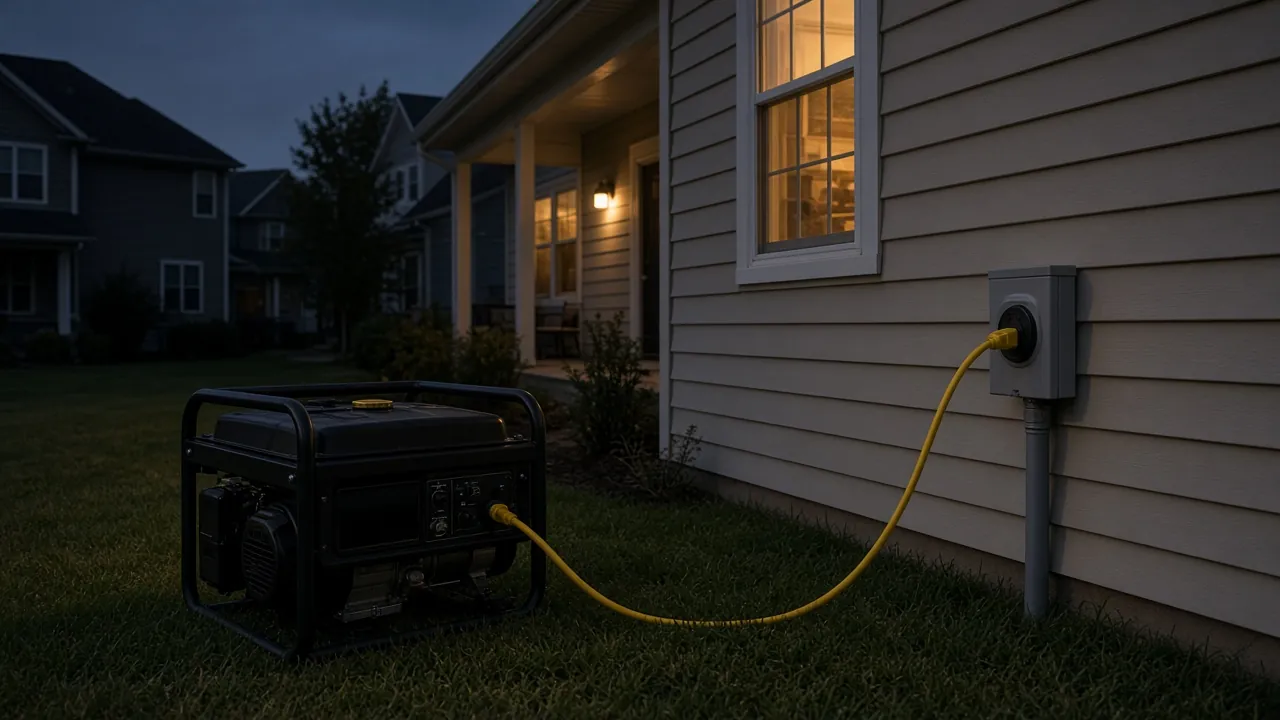
A 30 A, 120/240 V inlet tops out at 7,200 W, so a generator rated about 7,000–7,500 running watts with an L14-30R outlet uses the inlet fully. Typical essential circuits need about 4,440 W running and 6,790 W at the worst start.
| Essential circuit | Running W | Starting W | Voltage |
|---|---|---|---|
| Refrigerator | 700 | 2,200 | 120V |
| Chest freezer | 700 | 2,200 | 120V |
| Furnace blower, 1/2 HP | 800 | 2,350 | 120V |
| Sump pump, 1/2 HP | 1,050 | 2,150 | 120V |
| Well pump, 1/2 HP | 1,000 | 2,100 | 240V |
| LED lights, 10 × 9 W | 90 | — | 120V |
| TV, router and phone charging | 100 | — | 120V |
| Total | 4,440 | + 2,350 largest start = 6,790 W peak |
Typical planning figures from a published generator wattage chart, not measured from a specific model. Check your appliance nameplates. A 30 A, 240 V inlet can carry at most 30 × 240 = 7,200 W.
Generators that cover the whole list
- Honda EU7000iS — 5,500 running / 7,000 starting W, L14-30R
- Champion 7500W Dual Fuel (100891) — 7,500 running / 9,375 starting W, L14-30R
- FIRMAN T07571 Tri Fuel — 7,500 running / 9,400 starting W, L14-30R
- Predator 9500 Super Quiet Inverter — 7,600 running / 9,500 starting W, L14-30R
- Generac GP8000E COsense — 8,000 running / 10,000 starting W, L14-30R
- Westinghouse WGen9500DF — 9,500 running / 12,500 starting W, L14-30R
- DuroMax XP12000EH — 9,500 running / 12,000 starting W, 120/240V 30A twist-lock
- Pulsar G12KBN — 9,500 running / 12,000 starting W, 120/240V 30A twist-lock
- DuroMax XP13000EH — 10,500 running / 13,000 starting W, 120/240V 30A twist-lock
A larger generator does not push more than 7,200 W through a 30 A inlet; extra capacity only helps with starting surges. For more, a 50 A inlet is needed.
| Generator | 30 A outlet | 30 A inlet verdict |
|---|---|---|
| DuroMax XP13000EH | 120/240V 30A twist-lock | Runs |
| Westinghouse WGen9500DF | L14-30R | Runs |
| DuroMax XP12000EH | 120/240V 30A twist-lock | Runs |
| Pulsar G12KBN | 120/240V 30A twist-lock | Runs |
| WEN DF1100T | L5-30R (120V only) | Runs, surge risk |
| Generac GP8000E COsense | L14-30R | Runs |
| Predator 9500 Super Quiet Inverter | L14-30R | Runs |
| Champion 7500W Dual Fuel (100891) | L14-30R | Runs |
| FIRMAN T07571 Tri Fuel | L14-30R | Runs |
| Honda EU7000iS | L14-30R | Runs |
| Westinghouse iGen4500DFc | TT-30R | Won't run |
| Champion 4500W Dual Fuel Inverter (200988) | TT-30R | Won't run |
| WEN 56380i | TT-30R | Won't run |
| Generac iQ3500 COsense | L5-30R | Runs, surge risk |
| Generac GP3500iO | L5-30R | Runs, surge risk |
| Predator 3500 Super Quiet Inverter | None | Won't run |
| Honda EU3000iS | L5-30R | Runs, surge risk |
| Champion 2500W Ultralight Inverter (200951) | None | Won't run |
| Honda EU2200i | None | Won't run |
| Westinghouse iGen2200 | None | Won't run |
Safety first
- Run a generator outdoors only, at least 20 feet from the house, with the exhaust pointed away from doors, windows and vents. Never in a garage, basement, shed or crawlspace, even with the door open.
- Carbon monoxide is odorless and can kill in minutes. Keep battery CO alarms working inside the home.
- Never backfeed a house by plugging a generator into a wall outlet or dryer receptacle. It can energize utility lines and kill a lineworker or a neighbor.
- Connecting to home wiring requires a transfer switch or a listed breaker interlock with a power inlet box, installed by a licensed electrician and permitted where your jurisdiction requires it.