Brand comparison · Specs and prices checked on maker sites October 21, 2026
EcoFlow vs Jackery vs BLUETTI: which one should you buy?
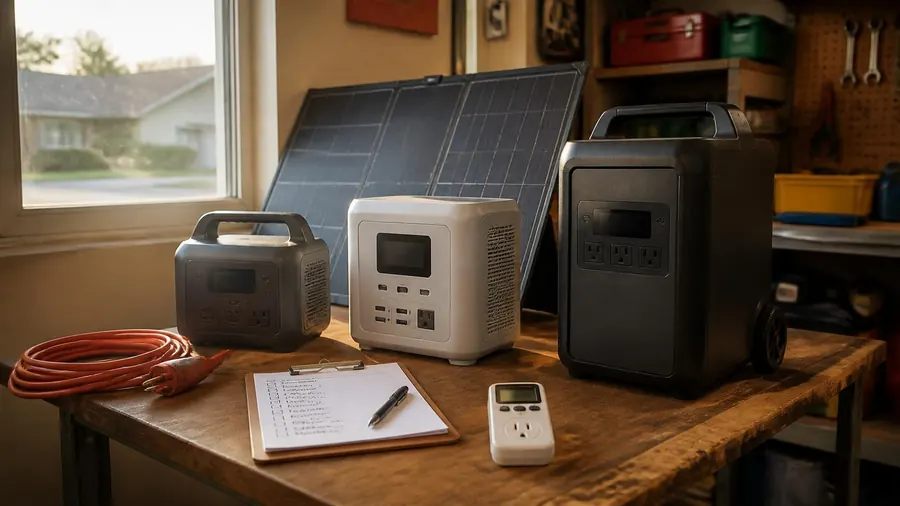
No brand wins everything, so buy the model, not the logo. EcoFlow is the pick when you want a battery that grows and switches over fast: the DELTA 3 Plus has a published <10 ms UPS, 1,000 W of solar input and expands to 5 kWh. Jackery wins on weight and simplicity: the Explorer 1000 v2 is 23.8 lb for 1,070 Wh, but its v2 models cap solar at 400 W and don't expand. BLUETTI wins on value: the AC180 is the cheapest per watt-hour here ($0.43/Wh); it was back in stock at BLUETTI on October 31, but on November 8 BLUETTI listed it out of stock (still $499, ships from December 14), and the AC200L costs the same $899 as a Jackery 2000 v2 while adding 1,200 W solar, 7,200 W surge and expansion to 8 kWh, at 62.4 lb.
The quick answer, by situation
| Your situation | Buy | Why | Also consider |
|---|---|---|---|
| Under $400: router, modem, laptop or a CPAP for a short outage | EcoFlow RIVER 3 Plus | $299, <10 ms UPS, 10.4 lb, and it can stack an extra battery to 858 Wh later. | EcoFlow RIVER 2 Pro (768 Wh, $389 sale) when it is back in stock; it was sold out at EcoFlow on October 21. |
| About 1 kWh, cheapest you can buy today | Jackery Explorer 1000 v2 | $559 ($0.52/Wh, black), the lightest of the 1 kWh units here at 23.8 lb, <20 ms UPS. | BLUETTI AC180 is cheaper per Wh ($0.43) and was back in stock at BLUETTI on October 31 (out of stock again on November 8, ships December 14), but lists no UPS time. |
| Bedside CPAP or other gear that must not blink | EcoFlow DELTA 3 Plus | <10 ms switchover, under 30 dB below 600 W, 12.6 V car port for a DC CPAP cord, 5-year warranty. | Jackery Explorer 1000 v2 (<20 ms). Read the medical note below first. |
| 1 kWh now, more later | EcoFlow DELTA 3 Plus | Takes EcoFlow extra batteries up to 5 kWh and 1,000 W of solar. | Jackery 1000 v2 and BLUETTI AC180 do not expand; Jackery lists the 1000 Plus battery pack as discontinued. |
| 2 kWh, most capability for the money | BLUETTI AC200L | $899 ($0.44/Wh, the same price as the Jackery 2000 v2), 7,200 W surge, 1,200 W solar, 20 ms UPS, TT-30 RV outlet, expands to 8,192 Wh. | It weighs 62.4 lb. If you carry it, see the next row. |
| 2 kWh you can actually carry | Jackery Explorer 2000 v2 | 39.5 lb for 2,042 Wh, <20 ms UPS, $899 on sale. | 400 W solar cap and no expansion. |
| Solar-first 2 kWh that grows | EcoFlow DELTA 2 Max | 1,000 W solar input and expansion to 6,144 Wh with two extra batteries. | BLUETTI AC200L takes 1,200 W of solar for less money but weighs more. |
| Whole-home circuits, 240 V well pump, transfer switch | EcoFlow DELTA Pro 3 | 4,096 Wh, 4,000 W at 120/240 V, 2,600 W solar, 10 ms UPS, 12 kWh per unit. | Jackery Explorer 2000 Plus expands to 12 kWh per unit and pairs two units for 240 V. |
Prices are each maker's own US store on October 21, 2026, and change weekly; sale prices are shown with the list price where the maker shows one. As an Amazon Associate we earn from qualifying purchases.
What each brand does best, and where it falls short
EcoFlow
Best at: charging speed, solar input per size, expansion and published UPS speed (<10 ms on the DELTA 3 Plus and RIVER 3 Plus, 10 ms on the DELTA Pro 3). The deepest range, from a 286 Wh RIVER to a 48 kWh DELTA Pro 3 system.
Watch for: the highest price per watt-hour of the three on most models, and no published UPS time for the DELTA 2 Max. The DELTA Pro 3's 5-year warranty needs app registration for the last 2 years.
Jackery
Best at: weight and simplicity. The Explorer 1000 v2 (23.8 lb) and 2000 v2 (39.5 lb) are the lightest units here for their capacity, both with <20 ms switchover, and sale prices are aggressive.
Watch for: 400 W solar input on the v2 models, no expansion on the v2 models, a warranty that is 3 + 2 years only through Jackery or authorized sellers, and Jackery's recommendation to use only Jackery panels. Battery cycles are rated to 70%, not 80%.
BLUETTI
Best at: price per watt-hour and big inputs. The AC200L takes 1,200 W of solar on a wide 12–145 V window and 2,400 W of AC, and BLUETTI is the only one of the three that publishes inverter self-consumption, so runtime math is honest.
Watch for: weight, thinner stock (the AC180 and AC70 were out of stock on October 21), Bluetooth-only app on the AC180, and no listed UPS time on the AC180.
Decision 1: budget tier and price per watt-hour
Price per watt-hour is the fairest first cut because it ignores marketing names. It is not the whole story: weight, UPS speed and solar input decide whether a cheap watt-hour is useful to you.
| Model | Capacity | Continuous / surge | Maker price, Oct 21 | $ per Wh | Weight | Stock at maker | Buy |
|---|---|---|---|---|---|---|---|
| EcoFlow RIVER 3 Plus | 286 Wh | 600 / 1,200 W | $299 | $1.05 | 10.4 lb | In stock | Amazon |
| EcoFlow RIVER 2 Pro | 768 Wh | 800 / 1,600 W | $389 (list $529) | $0.51 | 18.2 lb | Sold out at EcoFlow | Amazon |
| BLUETTI AC70 | 768 Wh | 1,000 / 1,500 W | $359 | $0.47 | 22.5 lb | Sold out at BLUETTI | Amazon |
| EcoFlow DELTA 3 Plus | 1,024 Wh | 1,800 / 3,600 W | $719 (list $799) | $0.70 | 27.6 lb | In stock | Amazon |
| Jackery Explorer 1000 v2 | 1,070 Wh | 1,500 / 3,000 W | $559 (black; white $589) | $0.52 | 23.8 lb | In stock | Amazon |
| BLUETTI AC180 | 1,152 Wh | 1,800 / 2,700 W | $499 | $0.43 | 35.27 lb | In stock Oct 31; out of stock Nov 8 (ships Dec 14) | Amazon |
| Jackery Explorer 1000 Plus | 1,265 Wh | 2,000 / 4,000 W | $619 (list $699) | $0.49 | 32 lb | In stock | Amazon |
| Jackery Explorer 2000 v2 | 2,042 Wh | 2,200 / 4,400 W | $899 (list $999) | $0.44 | 39.5 lb | In stock | Amazon |
| Jackery Explorer 2000 Plus | 2,043 Wh | 3,000 / 6,000 W | See maker | n/a | 61.5 lb | Mostly sold as kits (see Jackery) | Amazon |
| BLUETTI AC200L | 2,048 Wh | 2,400 / 7,200 W | $899 (list $1,599) | $0.44 | 62.4 lb | In stock | Amazon |
| EcoFlow DELTA 2 Max | 2,048 Wh | 2,400 / 4,800 W | $1,049 | $0.51 | 50 lb | Listed | Amazon |
| EcoFlow DELTA Pro 3 | 4,096 Wh | 4,000 / 8,000 W | $2,799 (list $3,299) | $0.68 | 113.54 lb | Limited stock | Amazon |
Surge: the figure each maker prints. EcoFlow's RIVER figures are X-Boost and BLUETTI's AC180 2,700 W is Power Lifting, both meant for heaters and kettles, not motor starts; see methodology. The Jackery 2000 Plus is sold mostly in kits on Jackery's store, so no standalone price is shown. As an Amazon Associate we earn from qualifying purchases.
Decision 2: how long the outage lasts
Runtime is nameplate Wh × 0.85 ÷ (load W + about 15 W). The 15 W is the inverter's own draw, which BLUETTI publishes for the AC180 (runtime formula) and owners have measured at about 17.5 W on a DELTA 3 Plus (owner test); the other makers don't publish it, so we use 15 W for every model. It barely matters at 300 W and matters a lot at light loads, the same method as our CPAP guide.
| Model | Capacity | 100 W: router, modem, lights, phones | 300 W: add a TV and laptop, or a small fridge running | 1,000 W: microwave or space heater |
|---|---|---|---|---|
| EcoFlow RIVER 3 Plus | 286 Wh | 2.1 h | 0.8 h | Over rating |
| EcoFlow RIVER 2 Pro | 768 Wh | 5.7 h | 2.1 h | Over rating |
| BLUETTI AC70 | 768 Wh | 5.7 h | 2.1 h | 0.6 h |
| EcoFlow DELTA 3 Plus | 1,024 Wh | 7.6 h | 2.8 h | 0.9 h |
| Jackery Explorer 1000 v2 | 1,070 Wh | 7.9 h | 2.9 h | 0.9 h |
| BLUETTI AC180 | 1,152 Wh | 8.5 h | 3.1 h | 1.0 h |
| Jackery Explorer 1000 Plus | 1,265 Wh | 9.3 h | 3.4 h | 1.1 h |
| Jackery Explorer 2000 v2 | 2,042 Wh | 15.1 h | 5.5 h | 1.7 h |
| Jackery Explorer 2000 Plus | 2,043 Wh | 15.1 h | 5.5 h | 1.7 h |
| BLUETTI AC200L | 2,048 Wh | 15.1 h | 5.5 h | 1.7 h |
| EcoFlow DELTA 2 Max | 2,048 Wh | 15.1 h | 5.5 h | 1.7 h |
| EcoFlow DELTA Pro 3 | 4,096 Wh | 30.3 h | 11.1 h | 3.4 h |
- Overnight blip (up to 12 hours): any 1 kWh unit covers a router and lights; buy on UPS speed and weight.
- One day with a fridge: 2 kWh. Our fridge outage guide puts a median bottom-freezer fridge at 538 kWh a year, about 61 W on average, and the compressor start needs a motor surge rating of about 1,200 W.
- Three days or more: either an expandable system (DELTA 2 Max to 6 kWh, AC200L to 8 kWh, DELTA Pro 3 to 12 kWh per unit, Jackery 2000 Plus to 12 kWh per unit) or a recharge plan from solar or a generator. Use the 3-day outage planner.
Decision 3: CPAP and UPS switchover
Medical safety notice: these are estimates from published specs, not medical advice. Confirm with your doctor or equipment supplier before relying on a power station for a CPAP, BiPAP or any medical device, and keep a backup plan. Jackery says its power stations are not recommended for medical devices or life-support equipment, and EcoFlow says its products are not intended for life-sustaining equipment. Which brand pays us a commission has no bearing on these claims.
If the station sits on the wall charger with the CPAP plugged into it, an outage should be a non-event, but only if it switches fast enough and doesn't time out. Published switchover times:
| Model | Published UPS / EPS switchover | 12 V car port | Notes |
|---|---|---|---|
| EcoFlow RIVER 3 Plus | <10 ms | None | AC only; 286 Wh is about 1.4 nights for a ResMed AirSense 11 with humidity off (7 W + 15 W inverter draw). EcoFlow also markets it as a PC/NAS UPS with a data port. |
| EcoFlow DELTA 3 Plus | <10 ms | 12.6 V, 10 A (126 W) | Under 30 dB below 600 W. |
| EcoFlow DELTA Pro 3 | 10 ms | Anderson 30 A port, 378 W total on 12 V DC | 10 ms UPS; EcoFlow's Smart Home Panel 2 switches circuits in 20 ms. |
| EcoFlow RIVER 2 Pro | <30 ms (EPS) | 12.6 V, 10 A | EcoFlow calls it EPS, not UPS. |
| Jackery Explorer 1000 v2 | <20 ms | 12 V, 10 A | Energy Saving Mode is on by default and shuts outputs after 12 h at ≤25 W; turn it off (manual). |
| Jackery Explorer 2000 v2 | <20 ms | 12 V, 10 A | |
| Jackery Explorer 2000 Plus | 20 ms (EPS) | 12 V, 10 A | Jackery calls it a 20 ms EPS. |
| BLUETTI AC200L | 20 ms | 12 V, 10 A regulated; 48 V RV port | 20 ms in BLUETTI's FAQ. |
| BLUETTI AC180 | Not listed (pass-through yes) | 12 V, 10 A regulated | Pass-through charging yes; no switchover time on the product page. |
| EcoFlow DELTA 2 Max | Not listed | 12.6 V, 10 A (126 W) | EcoFlow lists "AC Always On" for outages but no switchover time. |
Test it before you need it: with the CPAP running, pull the station's wall plug and make sure the machine keeps going. EcoFlow's safety instructions say to set the AC timeout to "never" for critical loads; check the same setting on any brand. Nights per machine and humidifier setting are in best power station for a CPAP and CPAP during a power outage.
Decision 4: recharging from solar
Solar input is where the brands split hardest. A day of solar harvest is roughly input watts × peak sun hours × 0.75 (heat, wiring and conversion losses, the SolarSized formula). At 4.5 peak sun hours, a typical sunny day across much of the US:
| Model | Max solar input | Solar Wh per sunny day at max input | Share of a full charge | Notes |
|---|---|---|---|---|
| EcoFlow DELTA Pro 3 | 2,600 W | 8,775 Wh | 100% | 1,600 W high-PV (30–150 V) + 1,000 W low-PV |
| Jackery Explorer 2000 Plus | 1,400 W | 4,725 Wh | 100% | up to 6 Jackery 200 W panels |
| BLUETTI AC200L | 1,200 W | 4,050 Wh | 100% | 12–145 V, one high-voltage input |
| EcoFlow DELTA 3 Plus | 1,000 W | 3,375 Wh | 100% | 2 × 500 W, 11–60 V |
| EcoFlow DELTA 2 Max | 1,000 W | 3,375 Wh | 100% | 2 × 500 W, 11–60 V |
| BLUETTI AC180 | 500 W | 1,688 Wh | 100% | 12–60 V |
| Jackery Explorer 1000 v2 | 400 W | 1,350 Wh | 100% | 2 × 8 mm DC inputs, 400 W combined |
| Jackery Explorer 2000 v2 | 400 W | 1,350 Wh | 66% | 2 × 8 mm DC inputs, 400 W combined |
| EcoFlow RIVER 3 Plus | 220 W | 742 Wh | 100% | |
| EcoFlow RIVER 2 Pro | 220 W | 742 Wh | 97% | 11–50 V |
Max solar input is the maker's product-page figure, October 21, 2026. Real panels rarely hit nameplate; winter sun hours are lower, so use your state's figure on SolarSized. Jackery says it does not recommend other brands' panels on the 2000 Plus. EcoFlow notes the DELTA Pro 3's 2,600 W needs ideal conditions and panels within its voltage window.
Bottom line: if you plan to live off solar in a long outage, Jackery's v2 models are the weak link. A Jackery 2000 v2 refills only about 66% on a good day, while the AC200L and DELTA 2 Max can refill 2 kWh in a single sunny day. For panel sizing by state, see what size solar panel for a CPAP.
Decision 5: warranty, cycle ratings and where you buy
| Model | Warranty (maker page) | Cycle rating |
|---|---|---|
| EcoFlow DELTA 3 Plus | 5 years | 4,000 to 80% |
| EcoFlow DELTA 2 Max | 5 years | 3,000 to 80% |
| EcoFlow RIVER 2 Pro | 5 years | 3,000 to 80% |
| EcoFlow DELTA Pro 3 | 5 years (3 + 2 with app registration) | 4,000 to 80% |
| Jackery Explorer 1000 v2 | 3 + 2 years* | 4,000 to 70% |
| Jackery Explorer 2000 v2 | 3 + 2 years* | 4,000 to 70% |
| Jackery Explorer 2000 Plus | 3 + 2 years* | 4,000 to 70% |
| Jackery Explorer 1000 Plus | 3 + 2 years* | 4,000 to 70% |
| BLUETTI AC180 | 5 years | 3,500 to 80% |
| BLUETTI AC200L | 5 years | 3,000 to 80% |
- Jackery*: 3 years standard plus 2 years extended, only for units bought from Jackery.com, Jackery-branded third-party stores or authorized dealers. Jackery's 2000 Plus FAQ tells Amazon buyers to register on Jackery's site to get the extra 2 years. Refurbished units get 6 months.
- EcoFlow: 5 years on the DELTA 3 Plus, DELTA 2 Max and RIVER 2 Pro pages. On the DELTA Pro 3 it is 3 years standard plus 2 years extended after you register in the EcoFlow app.
- BLUETTI: 5 years on the AC180 and AC200L pages.
- Cycle ratings aren't like-for-like: EcoFlow and BLUETTI rate cycles to 80% capacity, Jackery to 70%. A 4,000-cycle Jackery and a 4,000-cycle EcoFlow are not the same claim.
Decision 6: app and expandability
| Model | App | Expansion |
|---|---|---|
| EcoFlow RIVER 3 Plus | EcoFlow app | 858 Wh (EB300 / EB600 stack-on battery) |
| EcoFlow DELTA 3 Plus | EcoFlow app | 5 kWh (DELTA 3 / 2 / 2 Max / Pro 3 extra batteries) |
| EcoFlow DELTA 2 Max | Wi-Fi + Bluetooth | 6,144 Wh (2 extra batteries) |
| EcoFlow DELTA Pro 3 | Wi-Fi + Bluetooth | 12 kWh per unit, 48 kWh system |
| Jackery Explorer 1000 v2 | Jackery app | No |
| Jackery Explorer 1000 Plus | Wi-Fi + Bluetooth | Battery Pack 1000 Plus discontinued |
| Jackery Explorer 2000 v2 | Jackery app | No |
| Jackery Explorer 2000 Plus | Jackery app | 12 kWh per unit, 24 kWh with two units |
| BLUETTI AC180 | Bluetooth only | No (Power Bank Mode charging only) |
| BLUETTI AC200L | Wi-Fi + Bluetooth | 8,192 Wh (2 × B300) |
Expansion is the decision people regret most. A 1 kWh unit that takes an extra battery lets you start cheap and grow into multi-day backup; one that doesn't means buying a second station later. Wi-Fi matters if you want outage alerts or to check charge from work; Bluetooth-only apps work only in the same room. EcoFlow's DELTA 3 Plus app adds time-of-use and storm-warning charging, and the RIVER 3 Plus can tell a PC or NAS to shut down on low battery.
Our picks
Bedside UPS and grow-later 1 kWh
1,024 Wh · 1,800 W · 27.6 lb · $719 (list $799) at maker
The all-rounder: <10 ms UPS, 1,000 W solar, 5 kWh expansion, 4,000 cycles to 80%. Costs more than the Jackery up front; you get the growth path.
Lightest 1 kWh, best price in stock
1,070 Wh · 1,500 W · 23.8 lb · $559 (black) at maker
If you just want a light 1 kWh box for outages and camping, this is it. Skip it if you plan on serious solar (400 W cap) or more capacity later.
Most capability for $899 at 2 kWh
2,048 Wh · 2,400 W · 62.4 lb · $899 (list $1,599) at maker
Same $899 as the Jackery 2000 v2, but with 1,200 W solar, 7,200 W surge, expansion to 8 kWh and a TT-30 outlet for an RV. Heavy enough that it should live on a cart.
Lightest 2 kWh
2,042 Wh · 2,200 W · 39.5 lb · $899 (list $999) at maker
Two kilowatt-hours at under 40 lb with a <20 ms switchover. Same caveats as its smaller sibling: 400 W solar, no expansion.
Solar-heavy 2 kWh that expands to 6 kWh
2,048 Wh · 2,400 W · 50 lb · $1,049 at maker
For a solar-first setup: 1,000 W in, and two extra batteries take it to 6 kWh. No published UPS time, so not our first choice for a CPAP.
Whole-home and 240 V
4,096 Wh · 4,000 W · 113.54 lb · $2,799 (list $3,299) at maker
Real 120/240 V output for a well pump or transfer switch, 2,600 W solar, 12 kWh per unit. More home battery than portable.
Small desk or router UPS
286 Wh · 600 W · 10.4 lb · $299 at maker
A tidy UPS for a router, NAS or desk, with a data port for safe shutdown and an optional stack-on battery.
As an Amazon Associate we earn from qualifying purchases. Picks are based on published specs and maker prices; we did not receive products from any of these brands.
Head-to-head pages
- EcoFlow DELTA 2 vs Jackery Explorer 1000 v2
- EcoFlow DELTA 2 vs BLUETTI AC180
- EcoFlow DELTA 2 Max vs Jackery Explorer 2000 Plus
- EcoFlow RIVER 2 Pro vs BLUETTI AC70
- Jackery Explorer 2000 v2 vs 2000 Plus
- EcoFlow DELTA 3 Plus vs DELTA 2
Sources
- EcoFlow RIVER 3 Plus product page (UPS, solar, expansion, price)
- EcoFlow RIVER 2 Pro product page
- EcoFlow DELTA 3 Plus product page and specs
- EcoFlow DELTA 2 Max product page
- EcoFlow DELTA Pro 3 product page (warranty terms, solar, UPS)
- Jackery Explorer 1000 v2 product page, specs and FAQ (warranty, medical devices)
- Jackery Explorer 1000 Plus product page (battery pack discontinued)
- Jackery Explorer 2000 v2 product page and FAQ (not expandable)
- Jackery Explorer 2000 Plus product page and FAQ (warranty, panels)
- Jackery Explorer 1000 v2 user manual (Energy Saving Mode)
- BLUETTI AC180 product page (runtime formula, 15 W self-consumption, stock)
- BLUETTI AC200L page and FAQ (UPS 20 ms, expansion, solar)
- BLUETTI AC70 product page (stock)
- EcoFlow safety instructions (medical equipment, AC timeout)
- r/Ecoflow_community: measured DELTA 3 Plus idle draw (owner test)
- SolarSized methodology (solar harvest formula)
- All specs and prices checked October 21, 2026. Capacity, output and weight for every model: the source linked on each station page. Method: methodology.
Other guides
- Best power station for home backup
- Best power station for a refrigerator
- Best power station for a CPAP
- Best power station for camping
- Best power station for an RV
- Generator vs power station
Questions
Which is better, EcoFlow or Jackery?
It depends on what you value. EcoFlow charges faster, takes far more solar (1,000 W on the DELTA 3 Plus vs 400 W on the Jackery Explorer 1000 v2), expands to 5 kWh and publishes a faster UPS switchover (<10 ms vs <20 ms). Jackery is lighter (23.8 lb vs 27.6 lb for about 1 kWh) and cheaper ($559 vs $719 at the makers on November 1, 2026). For a grab-and-go 1 kWh box, Jackery; for home backup you may grow, EcoFlow.
Is BLUETTI as good as EcoFlow and Jackery?
On published specs, yes, and it is often the value pick. The AC180 is the cheapest per watt-hour of the models we priced ($0.43/Wh), and the AC200L lists 2,400 W continuous, 7,200 W surge, 1,200 W solar, a 20 ms UPS and expansion to 8,192 Wh for $899, the same price as the lighter Jackery 2000 v2. BLUETTI is also the only one of the three that publishes its inverter self-consumption (about 15 W on the AC180). The trade-offs are weight (the AC200L is 62.4 lb) and that the AC180 lists no UPS switchover time.
Which brand is best for a CPAP?
Pick a model, not a brand, and pick one with a published UPS switchover time so an outage doesn't wake you: the EcoFlow DELTA 3 Plus and RIVER 3 Plus list <10 ms, the Jackery Explorer 1000 v2 and 2000 v2 list <20 ms. Turn off auto-off timers (Jackery's Energy Saving Mode is on by default). Note that Jackery says its stations are not recommended for medical devices and EcoFlow says its products are not for life-sustaining equipment. Ask your doctor, and see our CPAP guide for nights per setup.
Which brand has the best warranty?
All three advertise 5 years on current models, with fine print. Jackery's is 3 years standard plus 2 years extended, and only for units bought from Jackery.com, Jackery-branded third-party stores or authorized dealers; Amazon buyers register the unit on Jackery's site for the extra 2 years; refurbished units get 6 months. EcoFlow lists 5 years on the DELTA 3 Plus, DELTA 2 Max and RIVER 2 Pro, and on the DELTA Pro 3 it is 3 years plus 2 more when you register in the EcoFlow app. BLUETTI lists 5 years on the AC180 and AC200L.
Can I add batteries later?
With EcoFlow and BLUETTI, often yes; with Jackery's v2 models, no. The DELTA 3 Plus takes EcoFlow extra batteries up to 5 kWh, the DELTA 2 Max up to 6,144 Wh, the DELTA Pro 3 up to 12 kWh per unit. BLUETTI's AC200L goes to 8,192 Wh with two B300 packs, but the AC180 can only be charged from a BLUETTI battery, not expanded. Jackery says the Explorer 1000 v2 and 2000 v2 are not expandable, and its page says the Battery Pack 1000 Plus has been discontinued; the Explorer 2000 Plus is Jackery's expandable option.
How long will a 1,000 Wh power station run my essentials?
Use nameplate Wh × 0.85 ÷ (load W + about 15 W of inverter draw). A 100 W load (router, modem, a few LED lights and phone charging) runs about 7.6 hours on a DELTA 3 Plus, 7.9 hours on a Jackery 1000 v2 and 8.5 hours on a BLUETTI AC180. A 2 kWh unit roughly doubles that.
More: all guides · best power station for each job
Shopping on a budget? Best power station under $500 compares the sub-$500 models by fridge surge, switchover time, solar and stock.