Guide
CPAP camping: power without hookups
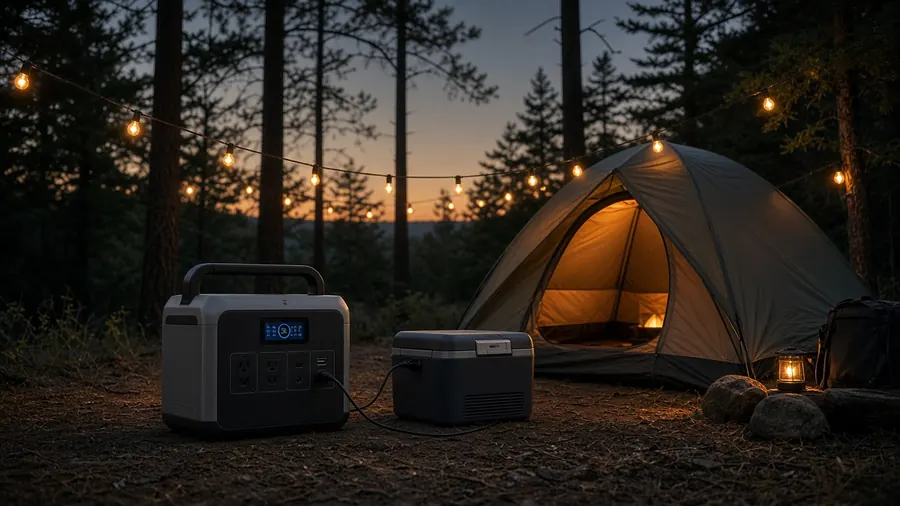
For camping, turn humidity off and use the DC cord if your machine has one. An AirSense 11 then needs about 56 Wh a night, so a 256 Wh station covers about four nights.
Medical safety notice: Will It Run? gives general power estimates only, not medical advice. Power draw varies by model, settings, pressure, humidifier and altitude. Before relying on any battery, power station, inverter or generator for a medical device, confirm approved power sources with the device manufacturer and your doctor or equipment supplier, and test your setup before an emergency. Never change prescribed settings to extend battery life. If your therapy is life-sustaining, keep the backup your supplier provides, register with your utility's medical-needs program, and have an evacuation plan. Run generators outdoors only, at least 20 ft from windows and doors, because of carbon monoxide risk. In an emergency, call 911.
| Machine and setting | Average draw | 8-hour night | Nights on a 1,024 Wh station, AC | On DC, best case | Source |
|---|---|---|---|---|---|
| ResMed AirMini travel CPAP | 6.3 W | 50 Wh | 5.1 | 17.3 | ResMed |
| ResMed AirSense 11 AutoSet, no humidifier | 7 W | 56 Wh | 4.9 | 15.5 | ResMed |
| ResMed AirSense 10 AutoSet, no humidifier | 7 W | 56 Wh | 4.9 | 15.5 | ResMed |
| ResMed AirSense 11 with HumidAir 11 humidifier, no heated tube | 19 W | 152 Wh | 3.2 | 5.7 | ResMed |
| ResMed AirSense 10 AutoSet with HumidAir humidifier | 22 W | 176 Wh | 2.9 | — | ResMed |
AC nights = 1,024 Wh × 0.85 usable ÷ ((watts + about 15 W inverter draw) × 8 hr). DC nights = 1,024 Wh × 0.85 ÷ (watts × 8 hr), a best case with the maker's DC converter (ResMed Air11, Air10 or AirMini) in a 12 V car port; — means DC isn't modeled for that setting (ResMed's AirSense 10 guide says humidity off on an external battery, and Philips publishes no DC figure). ResMed figures are lab measurements from ResMed's published power table; the Philips row is the 80 W power-supply ceiling, a worst case. The 15 W is the inverter's own draw: BLUETTI counts about 15 W of self-consumption in its AC180 runtime formula, and an owner test measured about 17.5 W on a DELTA 3 Plus; larger stations can idle higher. Method, DC converter limits and picks: CPAP power station guide. The RIVER 2, RIVER 3 Plus and SOLIX C300 DC figures use their 12 V car outputs (EcoFlow RIVER 2 manual: 100 W max; RIVER 3 Plus specs: 126 W max; Anker C300 guide: 12 V 10 A). The DELTA Pro 3 has 12 V Anderson and DC5521 outputs but no car socket, so it stays AC-only here.
Small stations for the campsite
Anker SOLIX F3800 row: nights use about 40 W of idle draw instead of 15 W, because Anker's FAQ for the F3800 Plus lists about 40 W with AC on and nothing connected (Anker). At CPAP loads that cuts its nights by roughly a third to a half; see the F3800 idle table. The F3800 DC column uses its 12 V ⎓ 10 A car charger output (Anker US user guide), which skips the inverter.
Nights of 8 hours. AC = nameplate Wh × 0.85 ÷ (average draw + about 15 W inverter draw). DC = nameplate Wh × 0.85 ÷ average draw, a best case with ResMed's Air11 DC converter in the 12 V car port; — means no car port is listed in the maker specs we checked. As an Amazon Associate we earn from qualifying purchases. The 15 W is the inverter's own draw: BLUETTI counts about 15 W of self-consumption in its AC180 runtime formula, and an owner test measured about 17.5 W on a DELTA 3 Plus; larger stations can idle higher. Method, DC converter limits and picks: CPAP power station guide.
To recharge in the field, see what size solar panel a CPAP needs.
CPAP DC cords on AmazonFolding solar panels on AmazonEcoFlow RIVER 2 on AmazonAs an Amazon Associate we earn from qualifying purchases.
More CPAP guides
- CPAP and BiPAP hub
- CPAP during a power outage
- How many watts does a CPAP use?
- BiPAP battery backup
- CPAP on DC vs AC from a power station
- Can a car battery run a CPAP?
- What size solar panel for a CPAP?
- Best power station for a CPAP
Questions
Can I use a CPAP while camping with no electricity?
Yes, with a power station or a DC cord and a battery. Humidity off makes the battery last several times longer.