Space heater guide · Maker specs and prices checked November 8, 2026
Best power station for a space heater: the 1,500 W limit
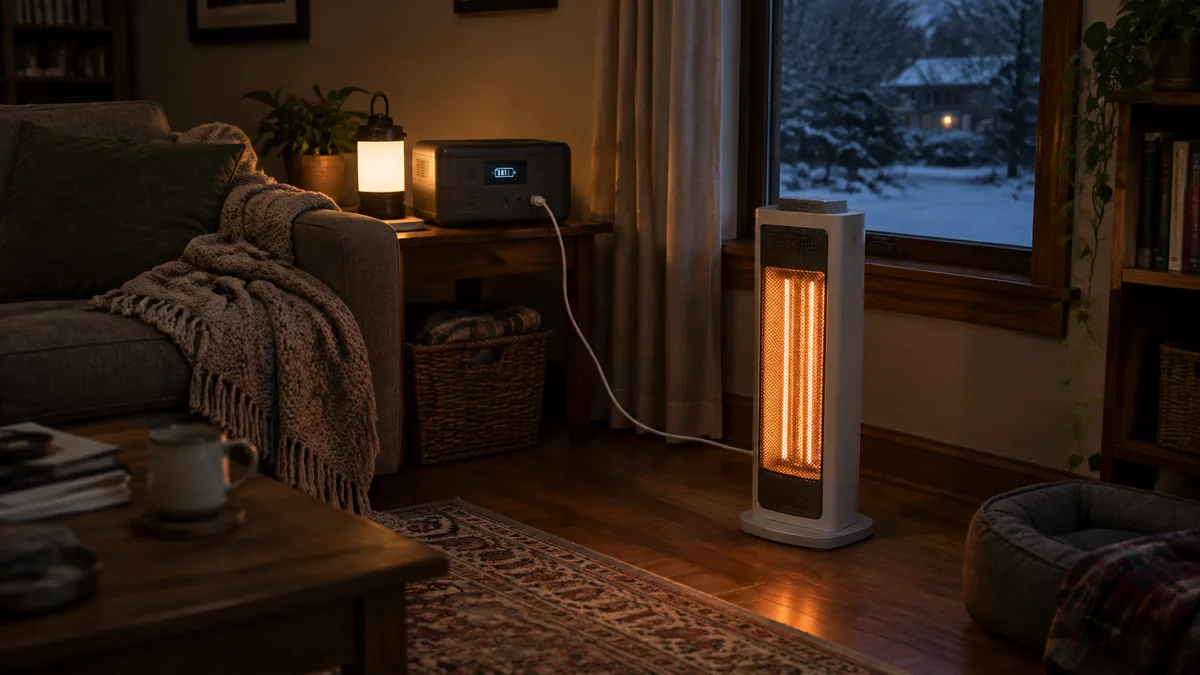
Most portable electric heaters in the U.S. top out at 1,500 W because that is about 12.5 A on a 120 V household circuit. A power station can run one, but only if its published continuous AC rating covers the setting you actually use, and only for a short time. Using our standard rule (watt-hours × 0.85 ÷ (watts + about 15 W of inverter draw)), the Jackery Explorer 1000 v2 (1,070 Wh, 1,500 W continuous) runs a 1,500 W heater about 36 minutes. A 2 kWh station such as the EcoFlow DELTA 2 Max or Jackery Explorer 2000 v2 lasts about 1.1 hours. Even the EcoFlow DELTA Pro 3 (4,096 Wh) manages about 2.3 hours on high. Eight hours at 1,500 W would take about 14,259 Wh of nameplate capacity, which is not a portable-station job. If the goal is staying warm through an outage, heat the person, not the room: Sunbeam lists its 60×80 heated throw (model 32810124) at 100 W, and the same 1,070 Wh station then lasts about 7.9 hours. Use a 1,500 W heater on a station only to take the chill off a closed room for less than an hour, and only on a unit whose continuous rating — not its surge or a heater-only boost mode — covers 1,500 W.
What portable heaters actually draw
Almost every portable electric heater sold for U.S. homes is a 1,500 W appliance. That is not a coincidence. A standard 15 A, 120 V receptacle can supply 1,800 W; 1,500 W is 12.5 A, which leaves a little room on the circuit and matches what heater manuals warn about. Honeywell's HCE317 series manual says outright, "This heater draws 12.5 amps," and lists a maximum of 1,500 W at 120 V. Lasko's official page for the 755320 (the live listing now 404s; this is the archived copy) calls it a 1,500 W digital ceramic heater with two heat settings, an 8-hour timer, oscillation, overheat protection and a cool-touch exterior.
| Heater and setting | Published watts | Source | Notes |
|---|---|---|---|
| Lasko 755320 ceramic, high | 1,500 W | Lasko 755320 product page (archived) | Official page: "1,500 watts of comforting warmth" and two quiet settings. Our high and low appliance pages record the same listing's electrical range, captured while it was live, as 900 W to 1,500 W (7.5 A to 12.5 A at 120 V). 7.5 A × 120 V = 900 W. |
| Lasko 755320 ceramic, low | 900 W | Same Lasko listing, low end of the published 900–1,500 W range | Use this number if your 755320 (or another heater whose nameplate says 900 W) is on low. Confirm on the unit. |
| Honeywell HCE317 series ceramic, high / low | 1,500 W / 750 W | Honeywell HCE311/317/322/323 series instruction manual | The manual says: choose low "to use 900 watts of power (750 watts on the HCE317 Series only)"; choose high "to use 1,500 watts of power." HCE317 series: 12.5 A, 120 V, 1,500 W max, 360° tip-over switch. |
| DeLonghi 1,500 W oil-filled radiator | 700 / 800 / 1,500 W | DeLonghi US FAQ: oil-filled radiator power settings | Official FAQ: a 1,500 W oil-filled model is min 700 W, mid 800 W, max 1,500 W. A 1,200 W model is 500 / 700 / 1,200 W. The element draws those watts when it is on; the oil keeps radiating after it cycles off. |
| Sunbeam 60×80 heated throw, model 32810124 | 100 W | Sunbeam product specifications | Maker listing: 100 watts, four heat settings, 4-hour auto-off, ETL certified. This is personal heat, not room heat. |
Two things follow. First, "a space heater" is not one load: the same household box can be 1,500 W, 900 W, 750 W or 700 W depending on the model and the switch. Second, ceramic fan heaters and oil-filled radiators use about the same watts while their elements are on. The difference is what happens when the thermostat opens. A ceramic heater with a fan stops making useful heat almost immediately. An oil-filled radiator, as DeLonghi notes of the type, keeps giving off stored heat after the element cycles. That can lower average watts in a closed room that has already warmed up. It does not change the continuous rating you need for the setting you selected, and we do not invent a duty cycle for a cold house with no central heat.
Continuous watts, not surge or boost
This is the rule that decides the rest of the page: only recommend a station whose published AC continuous rating covers the heater setting. For high, that means at least 1,500 W continuous. Peak, surge and "boost" numbers are the usual sources of bad advice on this topic.
- Surge or peak is a short overload, typically a second or two, so a fridge or pump motor can start. A heater is not a motor. It stays at nameplate watts until the thermostat or a safety switch opens.
- Resistive boost modes — EcoFlow X-Boost, BLUETTI Power Lifting, Anker SurgePad — are designed for heaters and kettles. BLUETTI's AC180 page says Power Lifting can run heating devices up to 2,700 W and, in the FAQ, "Do NOT use this unit to run an air conditioner or washing machine." Those modes often lower the output voltage. They are not the same as a 1,500 W continuous rating, and we do not use them to clear a station on this guide.
- Our individual appliance tables are more permissive. The Lasko 755320 high page marks some sub-1,500 W stations as "Runs" because those rows treat a documented resistive boost as eligible. This guide does not. If you want a heater to run as a sustained load, use the continuous number.
- Exactly 1,500 W continuous is the floor, not comfortable headroom. The Jackery Explorer 1000 v2, Jackery HomePower 1000 v2 and Goal Zero Yeti 1000X are all rated 1,500 W continuous. They can cover high, but you should not plug anything else into the AC outlets at the same time. Some inverters also derate in a hot room: the AC180 spec table limits discharge to 1,500 W between 86 °F and 104 °F. Keep the station out of the heater's airstream.
Stations in our set that do not clear 1,500 W continuous: EcoFlow RIVER 2 (300 W), Anker SOLIX C300 (300 W), Goal Zero Yeti 500X (300 W), EcoFlow RIVER 2 Max (500 W), EcoFlow RIVER 3 Plus (600 W), EcoFlow RIVER 2 Pro (800 W), BLUETTI AC70 (1,000 W), Anker SOLIX C800 (1,200 W). The Anker SOLIX C800 at 1,200 W and the BLUETTI AC70 at 1,000 W are the ones people most often expect to run a heater because 1,500 W appears somewhere on the spec sheet as a surge. It is not enough.
How long a charge actually lasts
Every hour on this page uses the same published rule as our methodology and the rest of the buying guides: hours = nameplate Wh × 0.85 ÷ (load W + about 15 W). The 0.85 is our allowance for inverter loss, not a measured efficiency for any one model. The 15 W is inverter self-consumption; BLUETTI publishes about 15 W in the AC180 runtime formula. On a 1,500 W heater that extra 15 W barely moves the answer (about 35.7 minutes vs 36.0 from a 1,070 Wh pack if you omit it). On a 100 W throw it matters a lot.
| Station | Wh | Continuous W | 1,500 W high | 900 W low | 750 W (HCE317) | 100 W throw |
|---|---|---|---|---|---|---|
| EcoFlow DELTA Pro 3 | 4,096 | 4,000 | 2.3 hr | 3.8 hr | 4.6 hr | 30.3 hr |
| Anker SOLIX F3800 | 3,840 | 6,000 | 2.2 hr | 3.6 hr | 4.3 hr | 28.4 hr |
| EcoFlow DELTA 2 Max | 2,048 | 2,400 | 1.1 hr | 1.9 hr | 2.3 hr | 15.1 hr |
| BLUETTI AC200L | 2,048 | 2,400 | 1.1 hr | 1.9 hr | 2.3 hr | 15.1 hr |
| Jackery Explorer 2000 v2 | 2,042 | 2,200 | 1.1 hr | 1.9 hr | 2.3 hr | 15.1 hr |
| Jackery Explorer 2000 Plus | 2,043 | 3,000 | 1.1 hr | 1.9 hr | 2.3 hr | 15.1 hr |
| Anker SOLIX F2000 (PowerHouse 767) | 2,048 | 2,400 | 1.1 hr | 1.9 hr | 2.3 hr | 15.1 hr |
| Goal Zero Yeti 1500X | 1,516 | 2,000 | 51 min | 1.4 hr | 1.7 hr | 11.2 hr |
| Jackery Explorer 1000 Plus | 1,265 | 2,000 | 43 min | 1.2 hr | 1.4 hr | 9.3 hr |
| BLUETTI AC180 | 1,152 | 1,800 | 39 min | 1.1 hr | 1.3 hr | 8.5 hr |
| Jackery Explorer 1000 v2 | 1,070 | 1,500 | 36 min | 60 min | 1.2 hr | 7.9 hr |
| Anker SOLIX C1000 | 1,056 | 1,800 | 36 min | 59 min | 1.2 hr | 7.8 hr |
| Jackery HomePower 1000 v2 | 1,024 | 1,500 | 34 min | 57 min | 1.1 hr | 7.6 hr |
| EcoFlow DELTA 2 | 1,024 | 1,800 | 34 min | 57 min | 1.1 hr | 7.6 hr |
| EcoFlow DELTA 3 | 1,024 | 1,800 | 34 min | 57 min | 1.1 hr | 7.6 hr |
| EcoFlow DELTA 3 Plus | 1,024 | 1,800 | 34 min | 57 min | 1.1 hr | 7.6 hr |
| Goal Zero Yeti 1000X | 997 | 1,500 | 34 min | 56 min | 1.1 hr | 7.4 hr |
Read the 1,500 W column first. A 1 kWh-class station is a 36-minute heater, give or take. A 2 kWh station is about 1.1 hours. The EcoFlow DELTA Pro 3 at 4,096 Wh is about 2.3 hours, and the Anker SOLIX F3800 at 3,840 Wh is about 2.2 hours. That is the entire portable range: you are buying minutes to a couple of hours of full-room heat, not a night.
Now read across a single row. On the Jackery Explorer 1000 v2, dropping from 1,500 W to 750 W roughly doubles the time (36 minutes to 1.2 hr), and dropping to a 100 W throw multiplies it by about thirteen (7.9 hours). The battery did not get bigger. The load got honest about what you actually need, which is to keep a person warm.
The overnight math
People shop this query hoping a power station will heat a bedroom all night. Rearranging the same formula for eight hours of continuous draw:
| Load | Watts used in the formula | Nameplate Wh needed for 8 hours | In this set? |
|---|---|---|---|
| 1,500 W heater on high | 1,500 + 15 | 14,259 Wh | No. The largest unit here is the EcoFlow DELTA Pro 3 at 4,096 Wh, about 3.5× too small. |
| 900 W low setting | 900 + 15 | 8,612 Wh | No. |
| 750 W Honeywell HCE317 low | 750 + 15 | 7,200 Wh | No. |
| 100 W Sunbeam heated throw | 100 + 15 | 1,082 Wh | Yes. Any ~1 kWh station in the table above covers it on paper; the Jackery Explorer 1000 v2 is estimated at 7.9 hours. |
Those 8-hour figures assume the load never cycles and the inverter stays on. They are planning numbers, labeled as estimates. If you truly need to keep a room at a set temperature for many hours — a nursery, a medical need, pipes in a crawlspace — a portable power station sized around a space heater is the wrong tool. See our house generator sizing guide and the 3-day outage plan, and follow the generator safety notes below rather than running a fuel heater indoors.
Every station compared on continuous output
Green-path stations below have at least 1,500 W of published continuous AC output. Runtime is for a 1,500 W element plus 15 W of inverter draw. Maker prices were checked on November 8, 2026, on the official stores linked from each station page; several change weekly, and two of the units we use as examples were unavailable at the maker today.
| Station | Wh | Continuous W | Clears 1,500 W high? | 1,500 W runtime | Maker price, Nov 8 2026 |
|---|---|---|---|---|---|
| Anker SOLIX F3800 | 3,840 | 6,000 | Yes | 2.2 hr | See station page; not rechecked today |
| EcoFlow DELTA Pro 3 | 4,096 | 4,000 | Yes | 2.3 hr | EcoFlow: $2,799 (list $3,299); Shopify listed the standalone unit unavailable |
| Jackery Explorer 2000 Plus | 2,043 | 3,000 | Yes | 1.1 hr | See station page; not rechecked today |
| EcoFlow DELTA 2 Max | 2,048 | 2,400 | Yes | 1.1 hr | EcoFlow: $1,029 (list $1,299), in stock |
| BLUETTI AC200L | 2,048 | 2,400 | Yes | 1.1 hr | See station page; not rechecked today |
| Anker SOLIX F2000 (PowerHouse 767) | 2,048 | 2,400 | Yes | 1.1 hr | See station page; not rechecked today |
| Jackery Explorer 2000 v2 | 2,042 | 2,200 | Yes | 1.1 hr | Jackery: $999, in stock |
| Goal Zero Yeti 1500X | 1,516 | 2,000 | Yes | 51 min | See station page; not rechecked today |
| Jackery Explorer 1000 Plus | 1,265 | 2,000 | Yes | 43 min | See station page; not rechecked today |
| BLUETTI AC180 | 1,152 | 1,800 | Yes | 39 min | BLUETTI: $499; page says out of stock, expected restock late November, ships from December 14 |
| Anker SOLIX C1000 | 1,056 | 1,800 | Yes | 36 min | See station page; not rechecked today |
| EcoFlow DELTA 2 | 1,024 | 1,800 | Yes | 34 min | See station page; not rechecked today |
| EcoFlow DELTA 3 | 1,024 | 1,800 | Yes | 34 min | See station page; not rechecked today |
| EcoFlow DELTA 3 Plus | 1,024 | 1,800 | Yes | 34 min | EcoFlow: $719 (list $799), in stock |
| Jackery Explorer 1000 v2 | 1,070 | 1,500 | Yes | 36 min | Jackery: black $559 (unavailable); dune white $509 (list $589, unavailable) |
| Jackery HomePower 1000 v2 | 1,024 | 1,500 | Yes | 34 min | Jackery: black $559 (list $649, in stock); white $549 (list $699, unavailable) |
| Goal Zero Yeti 1000X | 997 | 1,500 | Yes | 34 min | See station page; not rechecked today |
| Anker SOLIX C800 | 768 | 1,200 | No | — | See station page; not rechecked today |
| BLUETTI AC70 | 768 | 1,000 | No | — | See station page; not rechecked today |
| EcoFlow RIVER 2 Pro | 768 | 800 | No | — | See station page; not rechecked today |
| EcoFlow RIVER 3 Plus | 286 | 600 | No | — | See station page; not rechecked today |
| EcoFlow RIVER 2 Max | 512 | 500 | No | — | See station page; not rechecked today |
| Goal Zero Yeti 500X | 497 | 300 | No | — | See station page; not rechecked today |
| Anker SOLIX C300 | 288 | 300 | No | — | See station page; not rechecked today |
| EcoFlow RIVER 2 | 256 | 300 | No | — | See station page; not rechecked today |
The BLUETTI AC180 is the value curiosity in this table: 1,152 Wh, 1,800 W continuous, $499. That is enough continuous output to run high without Power Lifting, for about 39 min. On November 8, 2026, BLUETTI's own page still priced it at $499 but said the AC180 was out of stock, with an expected restock in late November and a note that the AC180 ships from December 14. We are not treating a preorder date as inventory.
Better ways to stay warm on a battery
If you already own a 1,500 W heater and a station that can run it, using high for 30–70 minutes to take the edge off a closed room is reasonable. Building a kit around that load is usually not. These alternatives cut watts, which is the only way a portable battery becomes an overnight heat plan.
Use the low setting you actually have
On a Lasko 755320, that is the 900 W end of the published range. On a Honeywell HCE317 series heater, the manual's low setting is 750 W — half of high. On a DeLonghi 1,500 W oil-filled radiator, the official minimum is 700 W. Any of those moves a 1 kWh station from roughly 35 minutes toward an hour or a bit more, and they let smaller inverters onto the list. The Anker SOLIX C800 (1,200 W continuous) and BLUETTI AC70 (1,000 W) clear 900 W and 750 W; the EcoFlow RIVER 2 Pro (800 W) clears 750 W but not 900 W. The EcoFlow RIVER 3 Plus at 600 W continuous does not clear 750 W without a boost mode we are not counting.
Oil-filled versus ceramic
NFPA's portable heater tip sheet lists both types: ceramic heaters warm air over a ceramic element with a fan; oil- or water-filled radiators circulate heated fluid and radiate. Watts while the element is on are similar. Oil-filled units are slower to warm a room, quieter (no fan), and keep radiating after the thermostat opens, which is why they sometimes use fewer watt-hours in a closed room that has already reached temperature. In a leaking, unheated house during an outage, plan as if the element will stay on. Place either type on a solid, flat floor, not a rug, which is also an NFPA item.
Heat the person: a listed heated throw
Sunbeam's 60×80 microplush heated throw (model 32810124) is specified at 100 W, with four heat settings and a 4-hour auto-off. That is the load that makes a 1 kWh station look like an overnight device (7.9 hours on the Jackery Explorer 1000 v2; 15.1 hours on the EcoFlow DELTA 2 Max). Even the EcoFlow RIVER 2 (256 Wh, 300 W continuous) is estimated at about 1.9 hr — short of a full night, but in a different league from a heater. A 4-hour auto-off means you may need to switch it back on; budget a second cycle if you plan to sleep longer than that, and follow the textile's own instructions. We are not recommending anyone disable a safety timer.
Dress in layers and close off rooms
These do not have nameplate watts, which is the point. Close doors to rooms you are not using. Hang a blanket over a doorway if the door is leaky. Put on a hat, wool socks and an extra sweater before you spend 1,500 W to heat air that will leak out of a 1,500-square-foot house. A closed 150-square-foot room — the kind of small-room figure Home Depot lists for the Lasko 755320 — is the only space a portable heater plus a portable battery can plausibly condition, and even then only briefly. Do not heat yourself with a gas oven; the CDC says never to heat a house that way.
Fire, tip-over, circuits and carbon monoxide
Affiliate relationships do not change any of the following. They come from safety agencies and from the manuals, not from anyone who sells a power station.
- Clearance. CPSC and NFPA both say to keep a portable heater at least 3 feet (1 metre) from anything that can burn, including bedding, furniture, drapes, papers — and people, in NFPA's wording. That 3-foot bubble should also include the power station. Hot exhaust on a lithium battery is a bad combination, and several stations derate or shut down when they get warm.
- Tip-over and overheat protection. NFPA says to choose a heater with a thermostat, overheat protection, and an auto shut-off if it tips over, and to place it on a solid, flat surface. Lasko's 755320 page lists overheat protection and a cool-touch exterior; it does not mention a tip-over switch. Consumer Reports' listing for the 755320 marks "Tip-over safety switch" as no. Honeywell's HCE317 series manual describes a 360° tip-over switch that disables the heater if it is tipped in any direction. If you are buying a heater to keep with a power station, prefer one whose maker documents tip-over shutoff.
- Never leave it running unattended, and never run it while you sleep. CPSC: never leave portable heaters on while sleeping, and do not leave them running unattended in a confined space around infants or people who may not be able to react to rising heat (CPSC also flags a hyperthermia hazard). NFPA: turn the heater off and unplug it when you leave the room or go to bed. A power station with UPS or EPS mode does not make an unattended heater a good idea.
- No extension cords or power strips. CPSC and NFPA both say to plug the heater directly into a wall outlet. Do the same at the station. CPSC estimated about 1,700 portable-heater fires a year from 2017 to 2019, with about 70 deaths and 160 injuries. NFPA notes that two in five deaths in space-heater fires involve portable electric heaters.
- One heater, one outlet, watch the circuit. A 1,500 W heater is already 12.5 A. On household power, do not share that receptacle with other loads, and stop if the plug, cord or faceplate is hot (a CPSC check). On a station, do not pile a kettle, microwave or another heater onto the same inverter. The continuous rating is a ceiling, not a suggestion.
- Electric heaters do not make carbon monoxide; generators and fuel heaters do. CDC and CPSC both say to run a portable generator outdoors only, more than 20 feet from windows, doors and vents, never in a home, garage, basement or shed, even with doors open. CDC also says never to heat a house with a gas oven, never to burn charcoal indoors, and never to use a portable gas camp stove or portable flameless chemical heater indoors. If a long outage tempts you toward a generator so you can keep running a heater, put the generator where the CDC says and use a battery-backup CO alarm.
- Test it before you need it. Plug the heater into the station on a day when the grid is up, set the station where it will actually sit (3 feet from the heater, dry, upright), turn the heater to the setting you plan to use, and watch the station's watt reading and any over-temperature warning for 15 minutes. If the inverter faults, the watt reading is above the continuous rating, or the station gets hot, that combination is not your outage plan.
Our picks
These are not a ranked listicle of every 1,500 W-capable box. They are the jobs that actually match what a portable battery can do with a heater.
Best if you truly need about an hour of 1,500 W heat
2,042 Wh · 2,200 W continuous
The practical 1,500 W pick if you already know you want about an hour of high heat in a closed room. 2,042 Wh and 2,200 W continuous, so high is inside the rating with 700 W of inverter headroom. About 1.1 hours on 1,500 W, 2.3 hr on 750 W, and about 15.1 hours on a 100 W throw. Maker price on November 8, 2026: $999, in stock at Jackery.
Same job, more inverter headroom
2,048 Wh · 2,400 W continuous
Same 2 kWh-class runtime as the Explorer 2000 v2, with more continuous headroom (2,400 W) and a 4,800 W motor-rated surge if the same station also has to start a fridge. About 1.1 hours on 1,500 W. Maker price on November 8, 2026: $1,029 (list $1,299), in stock at EcoFlow.
Longest portable runtime on high — still not overnight
4,096 Wh · 4,000 W continuous
The longest 1,500 W runtime in this set: 4,096 Wh, 4,000 W continuous, about 2.3 hours on high and about 30.3 hours on a 100 W throw. Still far short of an 8-hour heater night (14,259 Wh). On November 8, 2026 EcoFlow listed the standalone unit at $2,799 (list $3,299) and Shopify showed it unavailable. The Anker SOLIX F3800 (3,840 Wh, 6,000 W) is the other long-runtime option, about 2.2 hours on high.
The better overnight plan
A ~1 kWh station plus a listed 100 W heated throw
Example: Jackery Explorer 1000 v2 (1,070 Wh, 1,500 W) or Jackery HomePower 1000 v2 (1,024 Wh, 1,500 W) · Sunbeam model 32810124 at 100 W
About 7.9 hours of personal heat on the Explorer 1000 v2 versus 36 minutes of 1,500 W room heat. On November 8, Jackery priced the Explorer 1000 v2 at $559 black / $509 white, both unavailable, and the HomePower 1000 v2 at $559 black (in stock) / $549 white (unavailable). The BLUETTI AC180 (1,800 W continuous, about 39 min on high and 8.5 hours on a 100 W throw) is the cheaper 1 kWh-class option at $499 when BLUETTI actually has it; today the page said out of stock, ships from December 14.
As an Amazon Associate we earn from qualifying purchases. Picks are ranked on published continuous watts versus the heater setting, watt-hours at our standard runtime rule, and whether the job (an hour of room heat vs a night of personal heat) is one a portable battery can actually do. We did not bench-test these stations with a heater, and we received nothing from any brand. Station specs come from the source on each station page. Prices above are official-store figures we fetched on November 8, 2026, and will move.
Related guides
- Lasko 755320 ceramic heater, high (1,500 W) on every station
- Lasko 755320 ceramic heater, low (900 W) on every station
- Best power station for home backup
- Best power station for a fridge — if the same station also has to keep food cold
- 3-day outage plan and 24-hour outage plan
- What size generator for a house
- Best power station under $500
- All “best power station for” guides
Sources
- Lasko 755320 official product page, archived March 20, 2025 (1,500 W ceramic heater, two settings, overheat protection, cool-touch exterior; the live lasko.com URL returned 404 on November 8, 2026)
- Honeywell HCE311 / HCE317 / HCE322 / HCE323 series instruction manual (HCE317 low = 750 W, other series low = 900 W, high = 1,500 W; 12.5 A; 360° tip-over switch)
- DeLonghi US FAQ: power settings on oil-filled radiators (1,500 W models 700 / 800 / 1,500 W; 1,200 W models 500 / 700 / 1,200 W)
- Sunbeam heated merlot throw, model 32810124 (60×80, 100 W, 4 heat settings, 4-hour auto-off)
- CPSC, January 5, 2023: winter warning on space heaters, furnaces and fireplaces (about 1,700 portable-heater fires, 70 deaths and 160 injuries a year, 2017–2019; 3-foot clearance; no extension cords or power strips; never leave on while sleeping; generators 20 feet from the home)
- NFPA portable electric space heater safety tip sheet (3 feet from anything that can burn, including people; tip-over shutoff; overheat protection; no extension cords; turn off and unplug when leaving the room or going to bed; two in five space-heater fire deaths involve portable electric heaters)
- CDC: carbon monoxide poisoning basics (generators outdoors more than 20 feet from windows, doors and vents; never heat a house with a gas oven; no charcoal or portable fuel heaters indoors)
- Consumer Reports listing for the Lasko 755320 (1,500 W; tip-over safety switch marked no)
- BLUETTI AC180 product page and FAQ (1,800 W continuous, Power Lifting up to 2,700 W for heating devices, about 15 W self-consumption in the runtime formula, $499, out of stock / ships from December 14 as of November 8, 2026)
- Jackery Explorer 1000 v2 product page (1,500 W continuous; Nov 8 maker price $559 black / $509 white, both unavailable)
- Jackery HomePower 1000 v2 product page (1,500 W continuous; Nov 8 maker price $559 black in stock / $549 white unavailable)
- Jackery Explorer 2000 v2 product page (2,200 W continuous; Nov 8 maker price $999, in stock)
- EcoFlow DELTA 2 Max product page (2,400 W continuous; Nov 8 maker price $1,029)
- EcoFlow DELTA Pro 3 product page (4,000 W continuous; Nov 8 maker price $2,799, standalone listed unavailable)
- EcoFlow DELTA 3 Plus product page (Nov 8 maker price $719)
- Station capacity and continuous watts come from the source on each station page and stations.json. Method: methodology.
Questions
Can a portable power station run a 1,500 W space heater?
Yes, if the station's published continuous AC output is at least 1,500 W. That includes the Jackery Explorer 1000 v2, Jackery HomePower 1000 v2 and Goal Zero Yeti 1000X at exactly 1,500 W, and higher-output units such as the BLUETTI AC180 (1,800 W), Jackery Explorer 2000 v2 (2,200 W) and EcoFlow DELTA 2 Max (2,400 W). A 1,500 W surge or peak figure is not enough, because a resistive heater draws that load the whole time the element is on. Stations under 1,500 W continuous — including the BLUETTI AC70 (1,000 W), Anker SOLIX C800 (1,200 W) and EcoFlow RIVER 2 Pro (800 W) — are not recommended on high, even if a boost mode claims to run heaters.
How long will a 1 kWh power station run a space heater?
About 36 minutes on a 1,500 W setting, or about 60 min on a 900 W low setting and about 1.2 hr on a documented 750 W setting, using watt-hours × 0.85 ÷ (watts + 15 W). The Jackery Explorer 1000 v2 is 1,070 Wh; the Jackery HomePower 1000 v2 is 1,024 Wh and lasts about 34 minutes on high. These are estimates, not measurements. Thermostat cycling in a small, already-warm room can stretch them; a cold house during an outage often will not.
Why isn't a 1,500 W surge rating enough for a heater?
Surge and peak ratings describe a brief overload, usually meant for a motor starting. A space heater is a resistive load: it pulls its nameplate watts continuously until the thermostat opens. If the station's continuous rating is 1,000 W and its surge is 1,500 W, the inverter is not specified to hold 1,500 W. Treat the continuous number as the one that matters, and do not add other AC loads on top of the heater.
What size power station do I need to run a heater overnight?
For eight hours of continuous 1,500 W heat you would need about 14,259 Wh of nameplate capacity. At 900 W that is about 8,612 Wh, and at 750 W about 7,200 Wh. No portable station in our set reaches those figures. Eight hours of a 100 W heated throw needs about 1,082 Wh, which a 1 kWh LiFePO4 station covers with margin.
Is the low or 750 W setting a better use of the battery?
Yes, if the heater actually has that setting and the station's continuous rating covers it. <a href="https://www.honeywellstore.com/store/images/pdf/hce-300-ceramic-tower-heater-manual.pdf" rel="noopener" target="_blank">Honeywell's HCE317 series manual</a> lists low at 750 W and high at 1,500 W (other Honeywell series in the same manual use 900 W on low). On the Jackery Explorer 1000 v2, 750 W lasts about 1.2 hr versus 36 minutes on high. The EcoFlow RIVER 2 Pro (800 W continuous) can cover a 750 W setting but not 900 W or 1,500 W. Lower watts also leave inverter headroom so you can run a lamp or phone charger at the same time.
Are heated blankets a better use of a power station than a space heater?
For staying warm, usually yes. <a href="https://sunbeamhome.com/products/sunbeam-heated-merlot-throw-blanket-oversized-microplush-4-heat-settings-60x80" rel="noopener" target="_blank">Sunbeam publishes 100 W</a> for its 60×80 microplush heated throw (model 32810124, four heat settings, 4-hour auto-off). That is 6.7% of a 1,500 W heater, so a 1 kWh station goes from roughly half an hour of room heat to about 7.9 hours of personal heat. Follow the blanket's own instructions, including its auto-off, and do not bury a controller or fold a heated textile into a tight ball. This is about energy, not a claim that any textile is safer than a listed heater.
Can I use an extension cord between the heater and the power station?
<a href="https://www.cpsc.gov/Newsroom/News-Releases/2023/CPSC-Warns-Consumers-to-be-Cautious-When-Using-Space-Heaters-Furnaces-and-Fireplaces-This-Winter" rel="noopener" target="_blank">CPSC</a> and <a href="https://www.nfpa.org/-/media/project/storefront/catalog/files/safety-tip-sheets/portableheatersafetytips.pdf" rel="noopener" target="_blank">NFPA</a> both say to plug a portable heater directly into a wall outlet and never into an extension cord or power strip. Treat the station's AC outlet the same way: plug the heater straight into the station, and put the station close enough that you do not need a cord, but at least 3 feet from the heater so the exhaust does not cook the battery. Do not run the heater's cord under a rug.
Is it safe to run a space heater from a power station while I sleep?
CPSC says never leave a portable heater on while sleeping, and NFPA says to turn the heater off and unplug it when you leave the room or go to bed. That advice does not change because the outlet is on a battery. CPSC estimated that portable heaters were involved in about 1,700 fires, 70 deaths and 160 injuries a year from 2017 to 2019. Choose a heater with a tip-over shutoff and overheat protection, keep 3 feet of clearance, and never run it unattended. If you need warmth overnight, a listed heated throw or mattress pad with its own auto-off is the lower-watt option; still follow that product's instructions.